You picked a carrier. You picked a telecom billing platform. Service delivery is mapped. First wave of customer accounts is close to going live.
Then someone asks how agents are getting paid.
Most IT MSPs hit this wall in the same spot. Mid-implementation. No plan. A whiteboard full of red flags. Here's what nobody on the billing demo asked you:
- When an account's MRC changes mid-month, does the commission math adjust or stay on old numbers?
- Are telecom taxes and surcharges cleanly pulled out of the commissionable base, or are you overpaying every cycle?
- Can one system pay external agents and internal sales reps, or are you running two tools and a spreadsheet in the middle?
This post walks you through what makes telecom agent commissions different, why the tools you already have can't run them, and the 5 capabilities your platform actually needs before you launch. If you're adding voice to your stack anytime soon, read this before you sign anything.
4 Reasons Telecom Agent Commissions Break IT Sales Comp Logic
IT sales comp is simple. Quotas. Year-end bonuses. A spiff when someone lands a big logo. Finance runs the math once a month in a spreadsheet and moves on.
Telecom rewrites that entire model. IT and telecom have already converged in most MSP books, and the minute you add voice, UCaaS, or connectivity, your comp structure can't keep up.
Here are the four shifts that catch IT MSPs off guard.
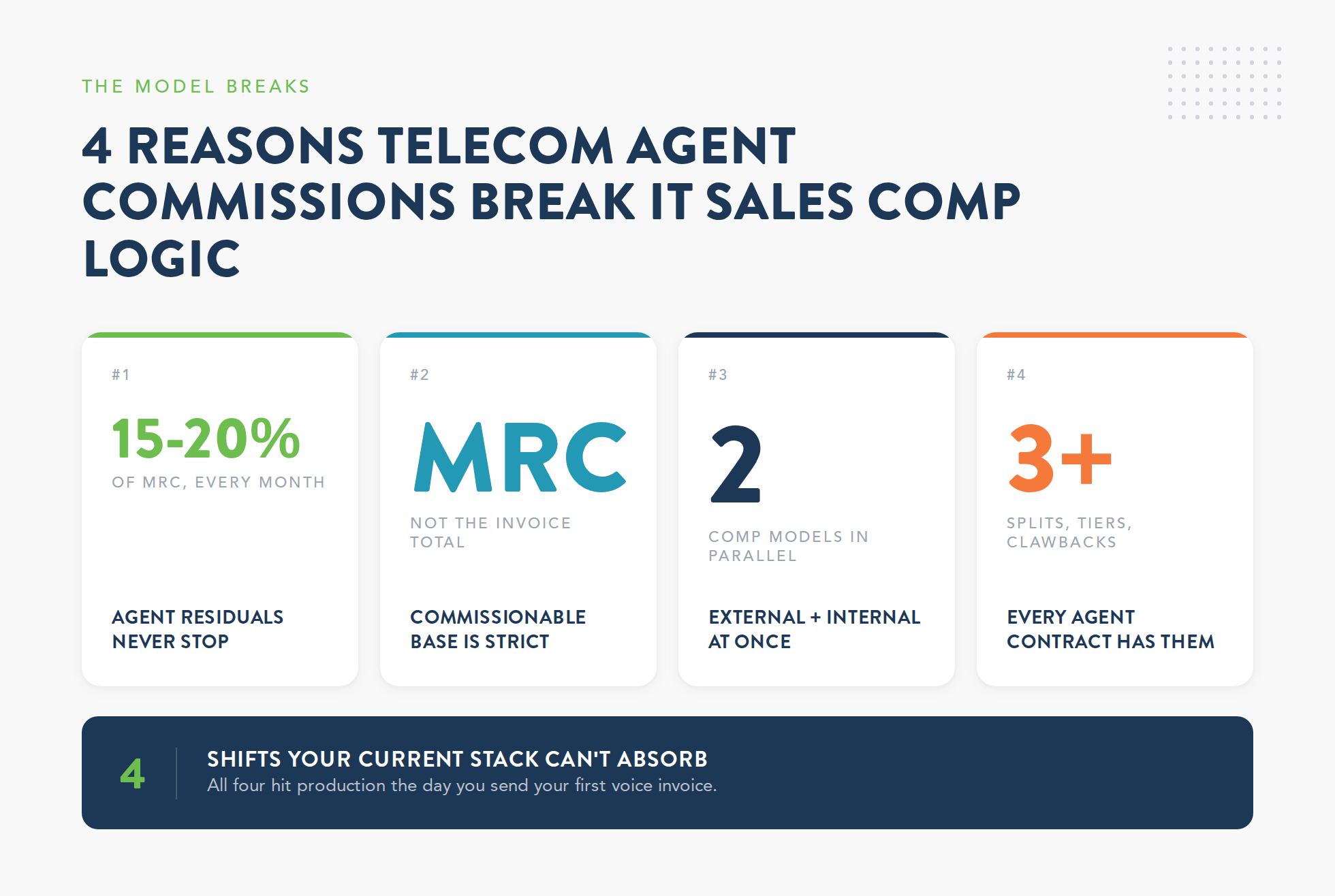
1. Telecom agent commissions are forever. IT spiffs aren't.
In the telecom channel, external agents don't take a finder's fee and walk away. They earn a percentage of the customer's monthly billings every single month, often for the life of the account. The rate is typically 15 to 20% of Monthly Recurring Charge, known as MRC.
Quick math on one account:
- $800/month voice customer
- 15% residual
- Agent earns $120/month, every month, forever
Now do that across 50 accounts and four different agents. That's $6,000/month of commission liability you have to calculate correctly, every cycle, or you're paying people wrong. Which you will.
2. Commissions run on MRC. Not the invoice total.
Agents commission on base service revenue. Not on taxes. Not on USF. Not on E911. Not on state surcharges. Not on one-time install fees.
That sounds obvious until you look at your invoice structure. If your billing system doesn't cleanly separate service revenue from regulatory fees at the line-item level, your commission math runs on the wrong number. A few bad percentage points every month, stacked across every agent, adds up fast.
Two outcomes, both bad:
- You overpay and eat the margin
- You underpay and get calls
3. Agent commission management has to run two models at once
Most MSPs adding voice end up running both structures in parallel:
- External channel agents: Residual commissions on MRC, paid monthly, forever
- Internal sales reps: One-time spiffs or quota-based bonuses
- Different accounting codes. Different reporting. Different cadences.
Try to run both through one spreadsheet and errors start month one. The platform has to handle both models natively, not as a workaround.
4. Splits, tiers, and clawbacks are standard in telecom agent commissions
They're standard in the telecom channel. Here's what shows up in the average agent contract:
- Splits: Two agents sharing one account at 60/40
- Tiers: Rate jumps from 15% to 18% once an agent crosses $50K in MRC
- Clawbacks: Full or partial commission pulled back if a customer churns inside 12 months
- Rate resets: Different rates at renewal vs. new sale
None of this is unusual. All of it has to run without someone calculating on a notepad.
| What’s different | IT Sales Comp | Telecom Agent Comp |
|---|---|---|
| Payout type | One-time spiff or quota bonus | Residual, monthly, for life of account |
| Payout basis | Closed deal value | Current month’s MRC |
| Rate | Flat or quota-tied | 15–20% of MRC, often tiered |
| Tax treatment | N/A | Must exclude taxes and surcharges |
| Splits | Rare | Common on referred or co-sold accounts |
| Clawbacks | Rare | Standard inside contract window |
| Update cadence | Per close | Every billing cycle |
Why Your CRM Can't Handle Telecom Agent Commissions
First instinct for most MSPs: shove it into Salesforce or HubSpot. The CRM already knows which rep owns which account. Can't we just build a workflow on top of it?
No. Here are the four reasons the CRM breaks the minute you try.
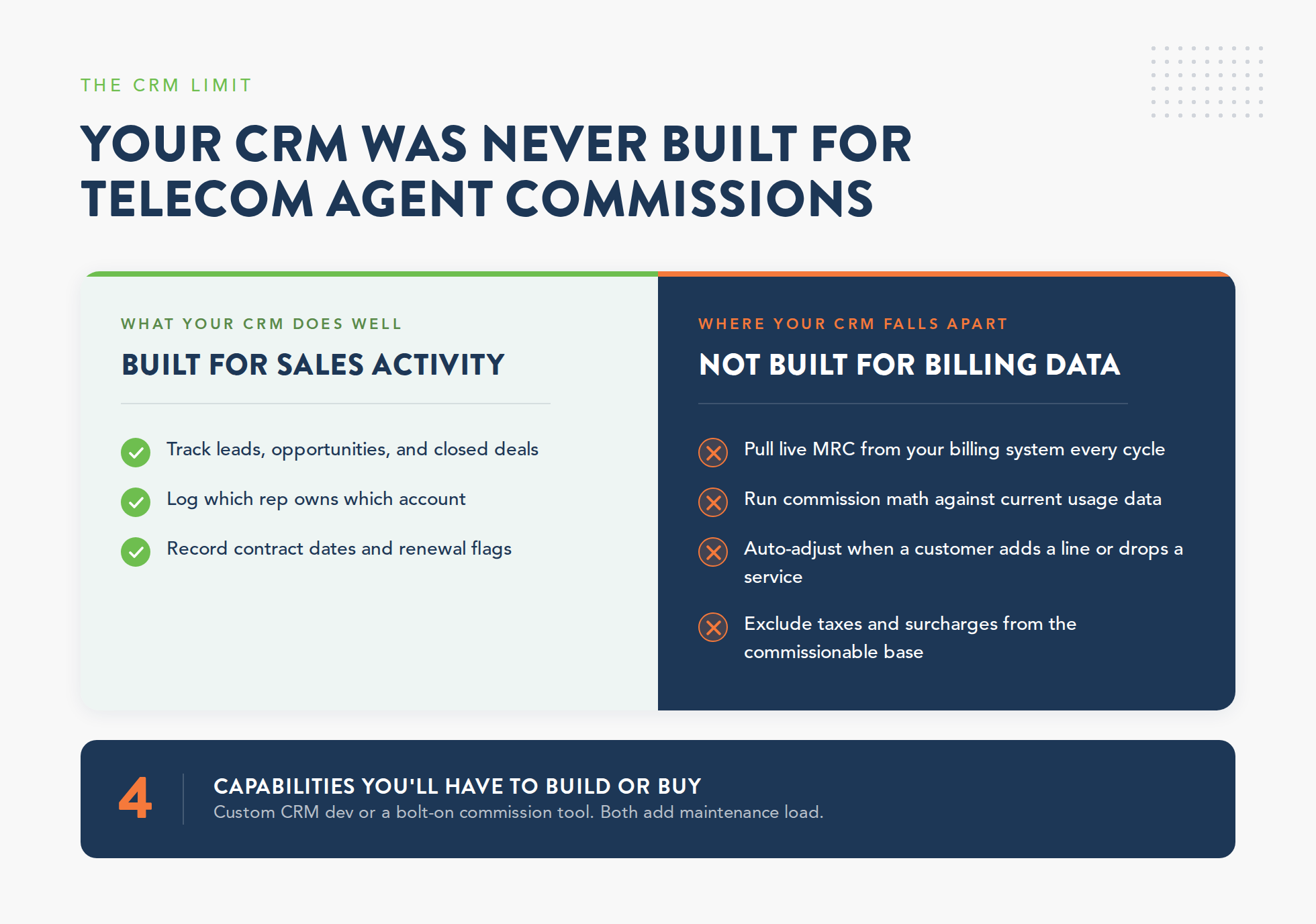
1. A CRM tracks activity. Telecom agent commissions need live billing data.
CRMs are built around the sales lifecycle. Leads become opportunities. Opportunities become closed deals. Each record has a contract value, a close date, and a renewal flag.
Telecom agent commissions don't care about any of that. They care about one number: what the customer actually got billed this month. That number lives in your billing system, not your CRM. The CRM can't reach in, pull it, rate it, or calculate a payout against it.
Different system. Different data. Different job.
2. Agent commission management breaks the second MRC changes
Here's how this falls apart in the real world:
- Customer adds two new phone lines mid-month. MRC jumps $80.
- Billing picks it up automatically on the next invoice cycle.
- The CRM never hears about it. Account record still shows the original MRC from the close date.
- Commission math runs off the CRM. Agent gets paid on the old number.
Repeat that across 50 accounts making small changes every month. Some payouts run hot. Some run cold. Nothing gets caught until an agent calls in.
Manual CRM updates don't fix this. Nobody has time to hand-update every account every time a customer adds a line or drops a service. So nobody does.
3. There's no commissionable base concept inside a CRM
Telecom agents commission on MRC. Not on taxes. Not on USF. Not on E911. Not on state surcharges. Not on one-time install fees.
A CRM doesn't know the difference between any of those. It sees "deal value" or "ARR" and stops there. Even if you piped billing data in, the CRM has no logic to strip regulatory fees out of the commissionable base before calculating a payout.
Every commission run overpays. Every cycle. Forever.
4. CRMs can't run splits, tiers, or clawbacks in telecom agent commissions
Standard telecom agent commissions logic includes:
- Two agents splitting one account at 60/40
- Rate tiers that jump at volume thresholds
- Clawbacks when a customer churns inside 12 months
- Rate resets at contract renewal
None of that is native to any CRM. You'd have to build custom fields, custom workflows, and custom formulas for every edge case. Then rebuild the logic every time an agent contract changes.
Why patching the CRM anyway doesn't fix it
Two options. Both bad.
- Custom development. A team of admins or consultants builds commission logic on top of the CRM. It works for six months. Then something breaks. Then the person who built it leaves. Now you own maintenance on a bespoke system nobody understands.
- Third-party commission bolt-on. You add another vendor, another login, another integration, another invoice. The bolt-on still pulls from the CRM, which is still working off stale data. Same problem, new tool in the middle.
Both paths add maintenance load to a stack that's already stretched. Neither fixes the root issue: the CRM isn't built to run this. No amount of configuration changes that.
.png)
Why Your Current MSP Billing Software Can't Accurately Calculate Agent Commissions
Generic MSP billing software has the opposite problem from a CRM. It knows exactly what every customer owes. The data is clean. The monthly run is reliable. What it can't do is calculate what each agent is owed.
Here are the four places your current MSP billing software breaks on telecom agent commissions.
1. It was built for flat-rate IT contracts, not agent commission management
Most PSA most IT shops run on was built for the managed IT model:
- Flat-rate contracts
- Time and materials work
- Project invoices
Residual commissions tied to variable MRC weren't on the roadmap. The system literally doesn't have the logic to pay someone a percentage of a changing bill every month.
2. It can't exclude taxes from the commissionable base
Taxes, USF, E911, and state surcharges have to come out of the base before commission math runs. Most IT-native billing tools don't separate those fees cleanly at the line-item level. So the agent payout runs on the full invoice amount instead of pure MRC.
You overpay every cycle. The overpayment compounds.
3. It can't handle splits, tiers, and clawbacks in telecom agent commissions
Two agents on one account. Rate bumps at volume thresholds. Clawbacks for early churn. Rate resets at renewal. None of this lives in standard billing logic. It gets ignored, calculated by hand, or both.
4. MSP billing automation ends where the spreadsheet starts
A person on your team becomes the bridge. Every cycle, they:
- Export the invoice run
- Drop it into a spreadsheet
- Cross-reference the agent roster
- Subtract taxes and fees line by line
- Calculate splits manually
- Send statements
That's not MSP billing automation. That's a part-time job with a dashboard.
It works at 10 accounts with two agents. It hurts at 50. It's not a business process at 200. MSPs who try to scale telecom agent commissions through a manual workflow end up in the same spot: agent disputes stacking up, month-end eating a full-time seat, and a late decision to buy real software to commission agents in telecom while the manual process keeps running during migration.
The lesson: commission capability belongs on your platform requirements list before you sign, not after.
What Telecom Agent Commission Errors Actually Cost You
Telecom agent commission errors aren't just dollar errors. They're relationship errors. And both sides of the cost add up faster than most MSPs realize.
Here are the four real costs MSPs hit when commission math runs wrong.
1. Commission overpayment from taxes in the commissionable base
When your billing tool commissions on the full invoice instead of pure MRC, you're paying agents on tax and surcharge dollars that were never revenue to begin with. A few percentage points on every account, every month, compounded across the whole channel for years.
Every wrong payout is margin you won't get back.
2. Revenue leakage from missed tiers, splits, and clawbacks
Independent research puts revenue leakage MSPs never catch at 5 to 15% of annual revenue across the whole billing process. Commission math sits squarely inside that range. Where it hides:
- Split commissions calculated wrong when two agents share an account
- Tier thresholds missed because nobody flagged the agent crossed $50K in MRC
- Clawbacks that never get pulled back when a customer churns inside the window
- Rate changes at renewal that don't get applied because the spreadsheet didn't know
Every one of those is money walking out the door. Quietly. For years.
3. Agent loyalty erodes when commission payouts are wrong
The dollar side is recoverable. The agent relationship is not.
Telecom agents can move their customers. Operational friction breaks the trust that keeps them selling for you. When payouts are wrong, agents notice. When they can't see their own accounts without calling in, they notice. When it takes three emails to resolve a split question, they notice.
4. Channel reputation damage that takes years to fix
Agents talk to each other. When a payout goes bad, the story travels.
The fallout:
- Existing agents send fewer new accounts your way
- They move existing customers to a competitor at renewal
- Your reputation inside the channel takes a hit that takes years to repair
15% of MSPs now list phone services and UCaaS as one of their fastest-growing service lines. More MSPs chasing the same agents every quarter. You don't want to be the one they're warning each other about.
.png)
Commission Leakage Calculator: How Much Revenue Are You Losing?
Four cost categories is easy to shrug off. Your own book is not.
Plug your voice customers, average MRC, commission rate, and a realistic error rate into the calculator below.
The math runs live. That 3-year number is usually what stops a conversation and starts a budget cycle.
5 Things Your Platform Needs to Run Telecom Agent Commissions Right
If you're evaluating a telecom billing platform and your roadmap includes agents, these five capabilities have to be native. Not on the roadmap. Not a third-party integration. Working, in the demo, on day one. If the tool you're looking at calls itself software to commission agents in telecom but can't show you all five, keep shopping. True agent commission management lives in the billing engine, not on top of it.
Here are the five must-haves.
1. Commission math tied to live billing data
Every account maps to one or more agents with a defined rate or split. After each billing run closes, the system pulls current MRC line items, calculates the payout, and generates the statement. No export. No sync. No Excel.
When an account gets reassigned mid-cycle, the assignment updates and the commission history stays intact.
2. Automatic exclusion of non-commissionable charges
Taxes, USF, E911, state surcharges, one-time install fees. All excluded from the commissionable base automatically.
Configure it at setup. Forget it. Never manually back anything out again.
3. External and internal agent commission management in one engine
One system handles:
- Residual commissions for external channel partners
- One-time spiffs for internal reps
- Quota bonuses at end of period
- Different accounting codes for each model
No second tool. No reconciliation spreadsheet in the middle.
4. An agent portal that shows real commission data
Agents log in and see:
- Their accounts
- Current MRC for each
- Recent billing activity
- Calculated commissions for the current cycle
- Historical statements
This is the single most underrated capability in a billing platform. Most of your agent disputes come from agents who can't see their own data. Give them a portal and disputes drop on their own.
5. Split, tier, and clawback logic built into the commission engine
If two agents share an account, the split runs automatically. If an agent crosses a tier threshold, their rate adjusts without someone rewriting a formula. If a customer churns inside a clawback window, the credit flows back to the next payout cycle.
Edge cases are where errors live. Native logic closes them.
Red flags in a telecom agent commissions demo
When you run a commission demo against a vendor, these are the warning signs:
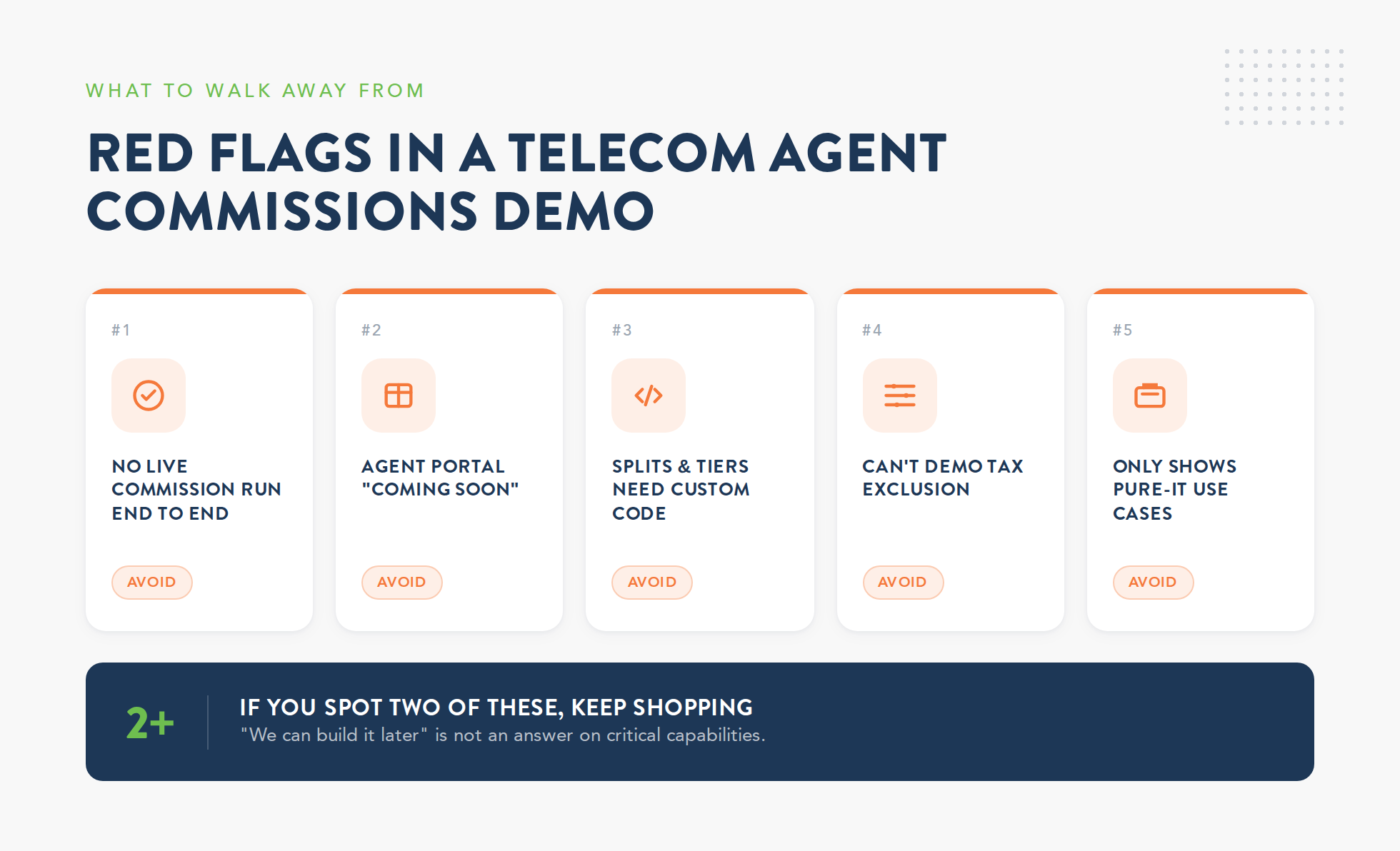
- They can't show a live commission run end to end in the demo
- The agent portal is "coming soon" or a third-party integration
- Splits and tiers require a script or custom code to configure
- They can't demo tax exclusion from the commissionable base
- The use case they keep showing is pure IT, not telecom
If any two of those show up in the first demo, move on. How the top 20% of MSPs run their ops comes down to not accepting "we can build it later" on critical capabilities.
Conclusion: Solve Telecom Agent Commissions Before You Bill the First Dollar
If agent commissions aren't on your platform requirements list today, the gap catches you mid-implementation. Manual spreadsheets, agent disputes, and a full-time reconciliation seat every month are the standard price of treating commissions as a post-launch problem. It's expensive, it's embarrassing, and it costs partner relationships that take years to rebuild.
Rev.io was built for the telecom billing model. Telecom agent commissions management is part of the core engine, not an afterthought. Account-level agent assignment, automatic exclusion of regulatory fees, live commission calc tied to billing runs, an agent portal with real account visibility, and native support for splits, tiers, and clawbacks are all in the product.
For IT MSPs launching voice for the first time, Rev.io pairs a telecom billing platform and a PSA with commission management on day one. The platform ships faster than the legacy billing stacks you're comparing against because the dev team is AI-native, which is why the capability gap keeps widening.
Request a demo to see the full platform end to end.
.png)