There’s a moment most MSP owners know well.
You’re on a plane, or finally at your kid’s soccer game, and your phone buzzes. A ticket escalation. A client question only you can answer. A tech waiting on a decision before they can move.
You built a 15-person company. You have a team. And somehow, everything still routes through you.
At first, it feels like responsibility. Then it starts to feel like a bottleneck.
And eventually, whether you’re thinking about selling or not, it becomes something bigger: a dependency your business can’t afford.
Because buyers are paying attention to that.
When a PE-backed rollup or regional aggregator looks at your business, the first question they ask is simple: what happens when this owner leaves?
If the honest answer is “things slow down,” “decisions stall,” or worse, “clients get nervous,” that risk doesn’t get ignored—it gets priced in.
Lower multiple. Earnouts that keep you tied in longer than you planned. Or no deal at all.
But here’s the part most owners miss: this isn’t really a people problem.
It’s an operational one.
If your team still needs you to make routine decisions, approve work, or step in on escalations, what you’ve built isn’t a fully functioning company—it’s a company that runs through you.
And growth doesn’t fix that. It amplifies it.
More clients. More tickets. More revenue. Same bottleneck—just under more pressure.
The way out isn’t adding more headcount. It’s building an operation where decisions, workflows, and accountability live outside of you.
For most MSPs, that foundation sits inside their PSA—whether they’ve fully leveraged it or not.
That’s the shift: from being the person who keeps things moving… to building a system that keeps things moving without you.
Whether you’re actively planning an exit or just want to take a real week off without interruptions, the goal is the same: an operation that doesn’t depend on you to function.
In this post, we’ll break down:
- The specific PSA capabilities that reduce owner dependency
- The metrics that reveal where you’re still the bottleneck
- And an Owner Independence Scorecard across eight areas so you know exactly what to fix first
The 15-Person MSP Trap (Why Growth Makes MSP Exit Planning Harder, Not Easier)
The 15-person stage is where it gets dangerous for MSP owners. You're too big to be scrappy and too small to have real management infrastructure. You've probably promoted your best tech to service manager, hoping they figure out the admin side. Your billing still happens because you're personally watching it. Your client relationships stay strong because clients know they can call you.
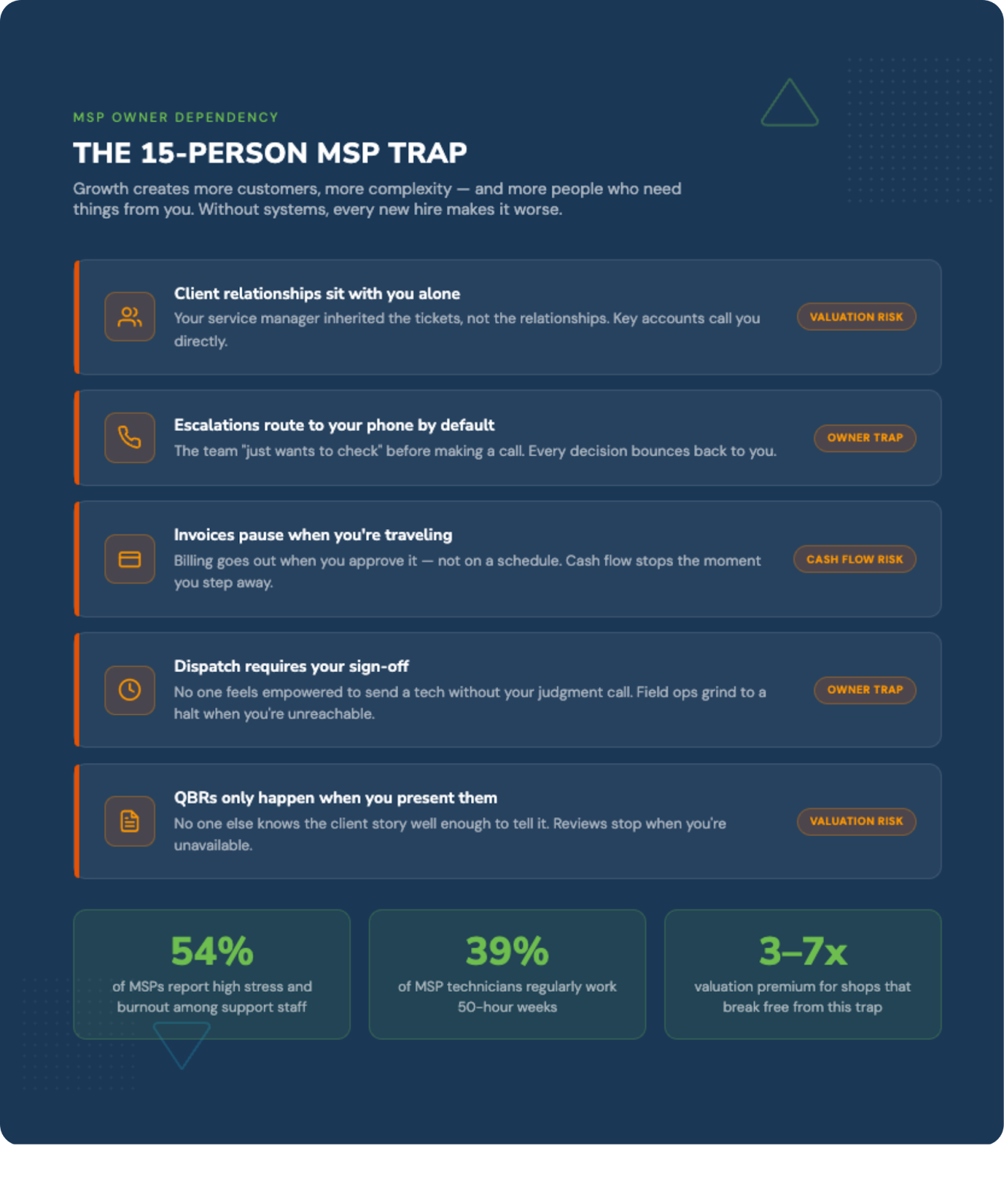
This is what the MSP community calls the "owner-dependent" business, and it's reaching a crisis point today. 54% of MSPs report high stress and burnout levels among their support staff, with techs clocking out faster than owners can hire and train replacements. That pulls owners back onto the tools they were supposed to delegate. Meanwhile, 39% of MSP technicians still regularly work 50-hour weeks. The ones who built something that can run without them are getting premium valuations from PE-backed buyers and regional aggregators. The ones who didn't are getting their time offered back, not a check.
The 15-person trap looks like this:
- You're the only person who knows the big clients: your service manager inherited the tickets, not the relationships
- Escalations land on your phone because the team "just wants to check" before making a call
- Invoices go out when you approve them, not on a schedule, meaning billing pauses every time you travel
- Dispatch decisions require your judgment: nobody feels empowered to send a tech without your sign-off
- QBRs only happen when you present them, because no one else knows the story well enough to tell it
If any of that describes your week, hiring more people won't fix it. Systems will. And for any MSP owner with exit planning on the horizon, systems aren't optional: they're the product you're selling to a buyer.
Once you can name the trap, the next question is obvious: what does it look like on the other side?
What "Owner-Independent" Actually Looks Like in Practice
Owner-independent doesn't mean the owner disappears. It means the owner chooses what to be present for.
In a well-systemized MSP, the following happens without the owner being involved:
- Tickets are triaged, assigned, and tracked automatically based on predefined rules tied to client type, SLA tier, and tech skill sets
- Techs in the field log their time, parts, and job completion without calling back to the office
- Invoices generate and go out on schedule, reconciled against time logs and inventory, with no human approval needed for standard billing cycles
- Escalation paths are defined and followed: the tech knows when to call the service manager, and when to call the owner (almost never)
- Reports run automatically, landing in the right inboxes every Monday morning
- New clients are onboarded through a documented process, not "whatever the owner does when they have time"
Getting there requires two things: documented processes and a PSA that enforces them. The PSA is where the real power lives.
The right PSA for MSP operations creates checkpoints and accountability. It makes it possible for your service manager to own service delivery, your ops lead to own dispatching, and your billing admin to own invoicing, without anyone needing to interrupt you for decisions that shouldn't require you.
Not all PSA platforms are built for this. Most are built to track work. The ones that create real MSP delegation infrastructure are built differently. Here's what to look for.
The 6 PSA Software Features That Actually Buy Back Your Time
Not all PSA software features matter equally for MSP owner independence. Here are the ones that specifically change an owner's relationship with their business:
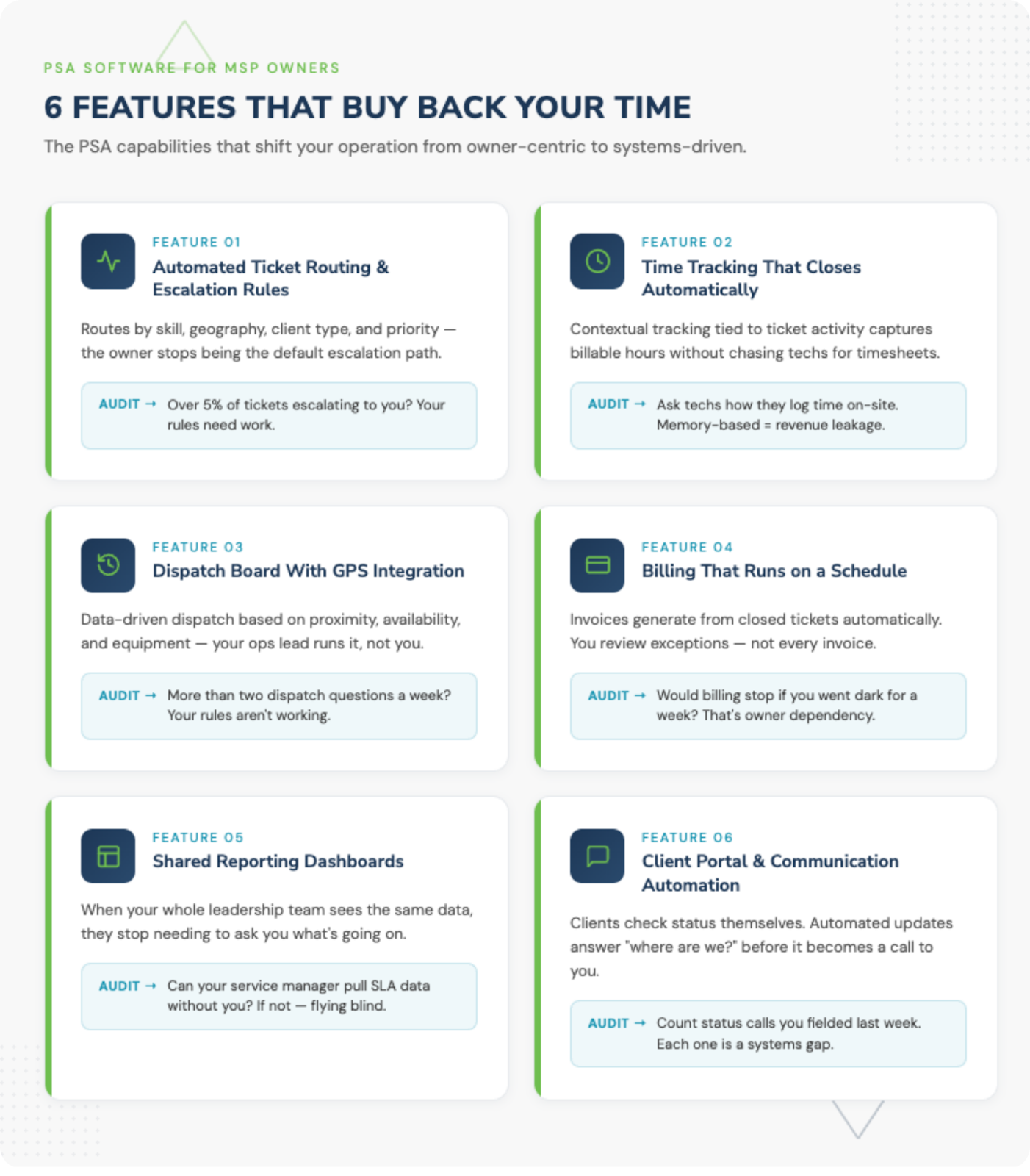
1. Automated Ticket Routing and Escalation Rules
When the system knows who handles what (skill, geography, client type, and priority) and enforces those rules automatically, the owner stops being the default escalation path. A well-configured service desk workflow can eliminate the majority of "quick questions" that hit an owner's inbox each week. The goal is a routing structure so complete that a ticket reaching you represents a genuine exception, not a daily occurrence.
Quick Check: Count how many tickets in the last 30 days escalated to you directly. If it's more than 5% of total ticket volume, your escalation rules aren't working, or don't exist yet.
2. Time Tracking That Closes Automatically
If techs have to remember to start and stop timers, they won't always do it. If the system tracks time contextually, tied to ticket activity, location, and job status, billable hours capture themselves. The owner stops chasing timesheets, and the billing leakage that comes with manual time entry disappears. For a 10-tech shop, even 15 minutes of unlogged time per tech per day compounds into serious revenue loss across a year.
Quick Check: Ask three techs right now how they log time when they're on-site without a laptop. If the answer involves doing it from memory later, you have a time tracking problem, not a people problem.
3. Dispatch Board With GPS Integration
When dispatch decisions are driven by data, including who's closest, who's available, and who has the right parts in their vehicle, dispatch becomes a process instead of a judgment call. The ops lead runs it. The owner sees a dashboard, not a Slack message asking where to send someone. Choosing the right dispatch and routing software is one of the fastest ways to remove the owner from day-to-day field operations.
Quick Check: How many times this week did someone ask you where a tech should go, or which job takes priority? More than twice means your dispatch rules aren't doing the work they should be.
4. Billing That Runs on a Schedule
When billing automation generates invoices from closed tickets and time logs automatically, the owner's signature goes from "required" to "optional." Billing runs. Exceptions surface. The owner reviews exceptions, not every invoice. This is one of the highest-leverage moves for MSPs trying to buy back time, because billing delays have a direct cost: slower collections, longer DSO, and cash flow pressure that keeps the owner tethered to operations.
Quick Check: Ask your billing admin: what happens to invoices if you take a week off with no cell service? If the answer is "they'd pile up," your billing process is owner-dependent.
5. Reporting Dashboards Accessible to the Whole Leadership Team
When your service manager, ops lead, and billing admin all have visibility into the same data, they stop needing to ask the owner what's going on. They can see it themselves. This transforms your leadership team from a group of reporters into a group of operators. The top-performing MSPs consistently invest in shared operational visibility as a baseline. Without it, your managers can't own their functions, because they're flying blind.
6. Client Portal and Communication Automation
When clients can check ticket status themselves, and when the system sends updates automatically at defined milestones, the owner stops being the default client communication channel. This alone recovers hours per week for most MSP owners. It also reduces the anxiety that keeps owners tethered to their phones, because clients have a self-service layer that answers the "what's the status?" question before it becomes a call.
Each of these features saves time on its own. Together, they shift the operating model of the entire business from owner-centric to systems-centric, and that shift has a direct impact on what your business is worth.
Metrics That Tell You If Your MSP Could Run Without You (For a Week)
Here's a gut-check. Could your MSP operate for one full week, seven days, with you completely unreachable? Not traveling and checking email on the plane. Truly unreachable.
If that question creates anxiety, here are the specific metrics to look at:
1. Escalation Rate to Owner
How many tickets in an average week escalate to you specifically? More than three is a problem. MSPs with well-configured PSA ticketing workflows typically see owner escalation rates below 2% of total ticket volume. If you're above that threshold, your escalation rules need work, or your service manager needs a clearer mandate.
2. Billing Delay
If you went offline today, how many days before invoices stopped going out? If the answer is "immediately," your billing process is owner-dependent. Billing should run on a schedule with zero input from you. Anything less is a cash flow risk and a sign that your operational infrastructure isn't built for scale.
3. Dispatch Decision Frequency
How many times per week does someone ask you where a tech should go, or what job takes priority? If it's more than twice, your dispatch rules aren't doing their job. Dispatch is one of the easiest areas to systematize with the right PSA, and one of the most common places owners get stuck in the loop.
4. Client Relationship Coverage
How many of your top 10 clients have a primary relationship with someone other than you? If the answer is fewer than five, you have concentration risk. Buyers evaluate this directly, because a business where key client relationships sit with the owner is a business that loses clients when the owner leaves. That risk gets priced into the deal.
5. Documentation Coverage
What percentage of your service delivery workflows are documented somewhere your team can find and follow without asking you? Research on MSP operational maturity consistently shows documentation coverage as one of the strongest predictors of scalability. If your top 20 workflows live in your head, they don't exist as an asset. They exist as a liability.
These metrics matter as much for your valuation as they do for your personal well-being. Buyers pay a multiple on EBITDA, but they apply discounts for risk. Owner dependency is consistently one of the largest risk discounts in MSP acquisition pricing, and it's entirely preventable. Strong fundamentals can add 3x to 7x to a base valuation. Weak ones cost you that and your negotiating leverage.
Once you know where you stand, use the Owner Independence Scorecard below to benchmark your MSP across eight operational areas.
Owner Independence Scorecard: How Systems-Driven Is Your MSP?
Rate each area 1-5. (1 = fully owner-dependent. 5 = fully systematized.)
Every point left on this scorecard represents either a discount on your eventual exit multiple, or another week you can't take off without the business suffering.
MSP Exit Planning: Why Buyers Pay More for Systems-Driven Shops
The MSP M&A market is active, and the consolidation isn't slowing. For owners with MSP exit planning in mind, the timing matters: PE-backed rollups, regional aggregators, and strategic buyers are all actively looking for well-run shops with recurring revenue, documented processes, and teams that execute without founder involvement. Median EBITDA multiples for MSPs with strong operational fundamentals are running above 11x. For owner-dependent shops, that number drops significantly before negotiations even start.
The multiple you get reflects risk as much as revenue. The central risk question in any MSP acquisition is: what happens when the owner leaves?
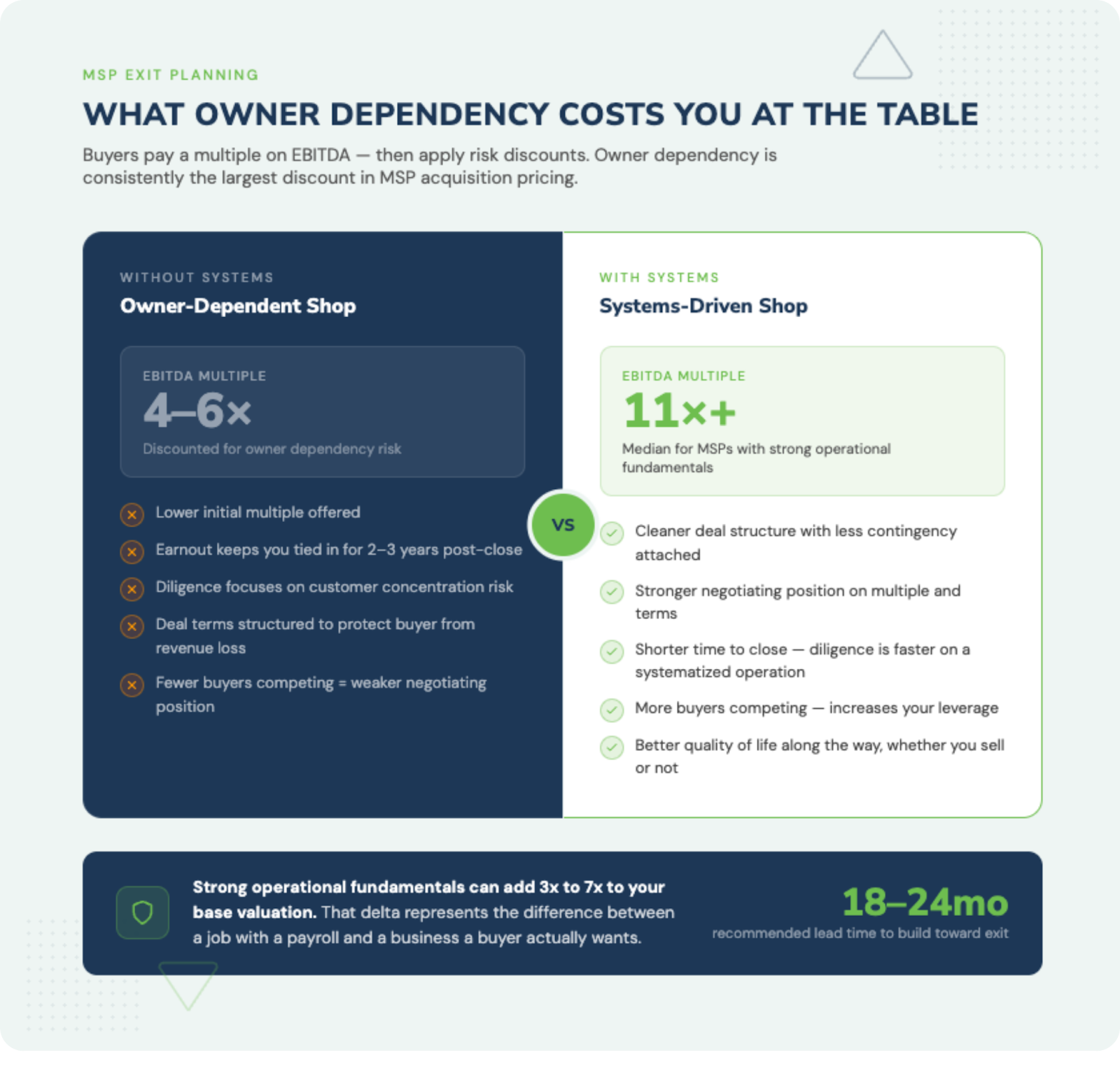
If the answer is unclear, expect these outcomes:
- A lower initial multiple
- An earnout structure that keeps you tied to the business for 2-3 years post-close
- Buyer due diligence that focuses heavily on customer concentration and owner dependency
- Deal terms designed to protect the buyer from revenue loss after you exit
If the answer is clear, here's what changes:
- Cleaner deal structure with less contingency attached
- Stronger negotiating position on multiple and terms
- Shorter time to close because diligence is faster on a systematized operation
- More buyers competing, which increases leverage
Effective MSP exit planning means building a real business, not a job with a payroll attached. The byproduct is a better quality of life along the way, whether you ever sell or not.
The PSA is the operational backbone that makes this possible.
Documentation lives in it. Workflows enforce through it. The team reports against it. When those things are in place, the owner becomes optional. And optional is exactly where you want to be, whether you're heading toward an exit or just want to take a week off without your phone buzzing every four hours.
The right PSA software for your MSP doesn't just track work, it enforces process, surfaces exceptions, and empowers your team to operate independently. That's the difference between a tool that records activity and a platform that creates infrastructure.
Conclusion: Start Building the Business You Can Actually Leave
Most MSP owners build something impressive and then spend years trapped inside it. The goal isn't to make yourself irrelevant, it's to make yourself optional. When you show up, it's because you chose to, not because the business stops without you.
The PSA you run is either building toward that or pulling you further away from it. Tools that only track work record your dependency. Tools built for delegation, with automated routing, scheduled billing, GPS-linked dispatch, and shared reporting, create the infrastructure that makes owner independence possible.
Rev.io's PSA is built specifically for MSP owners who are done being the default answer to every question. It brings ticketing, dispatch, time tracking, billing automation, and reporting into a single platform, so your team can run operations and you can see what's happening without being the one who makes it happen.
If you're ready to benchmark your operation and see what a systems-driven MSP actually looks like, book a walkthrough with the Rev.io team.