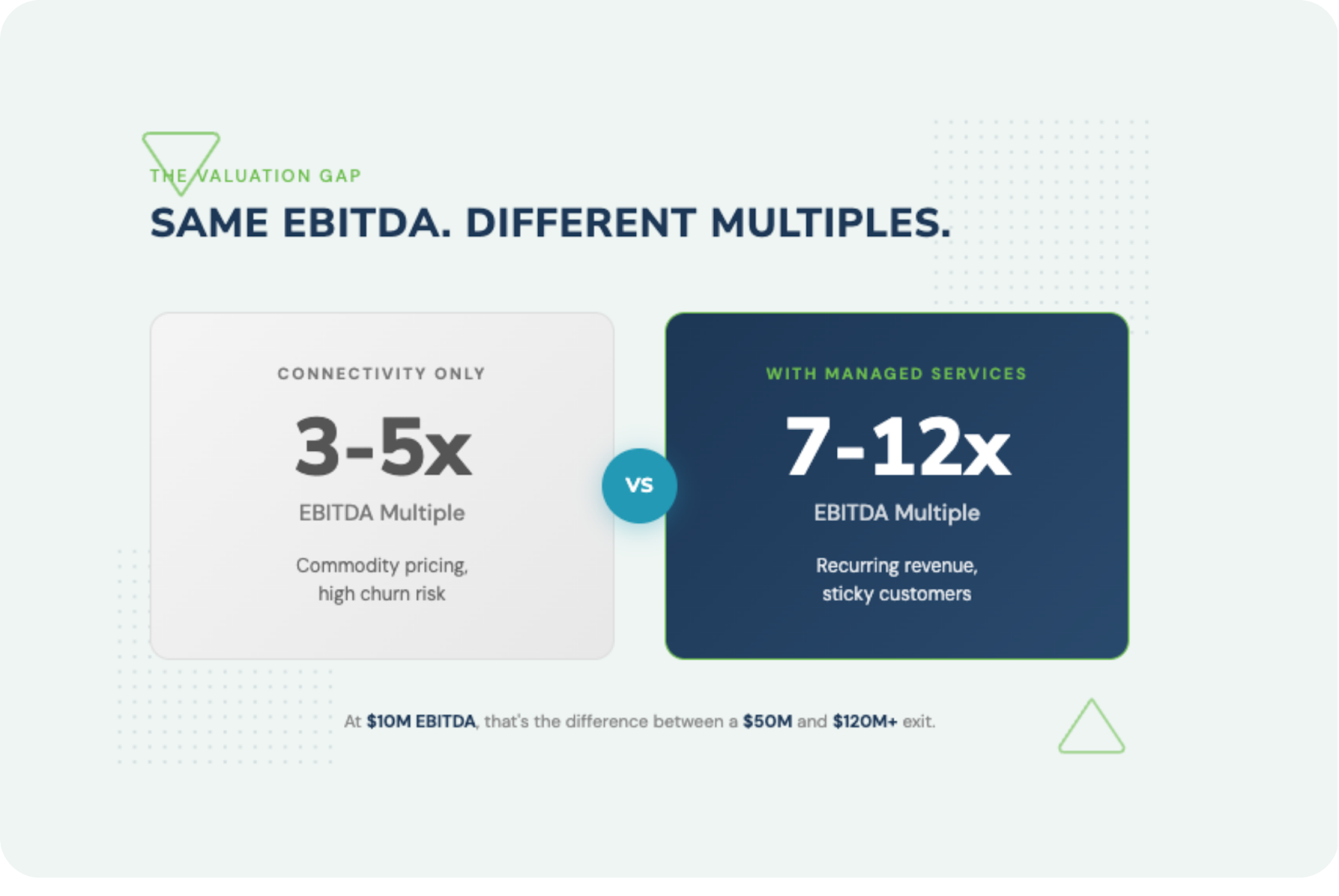
Picture two CSPs. Same revenue. Same EBITDA. Same number of employees. One sells for $50M. The other sells for $120M. The difference comes down to revenue mix.
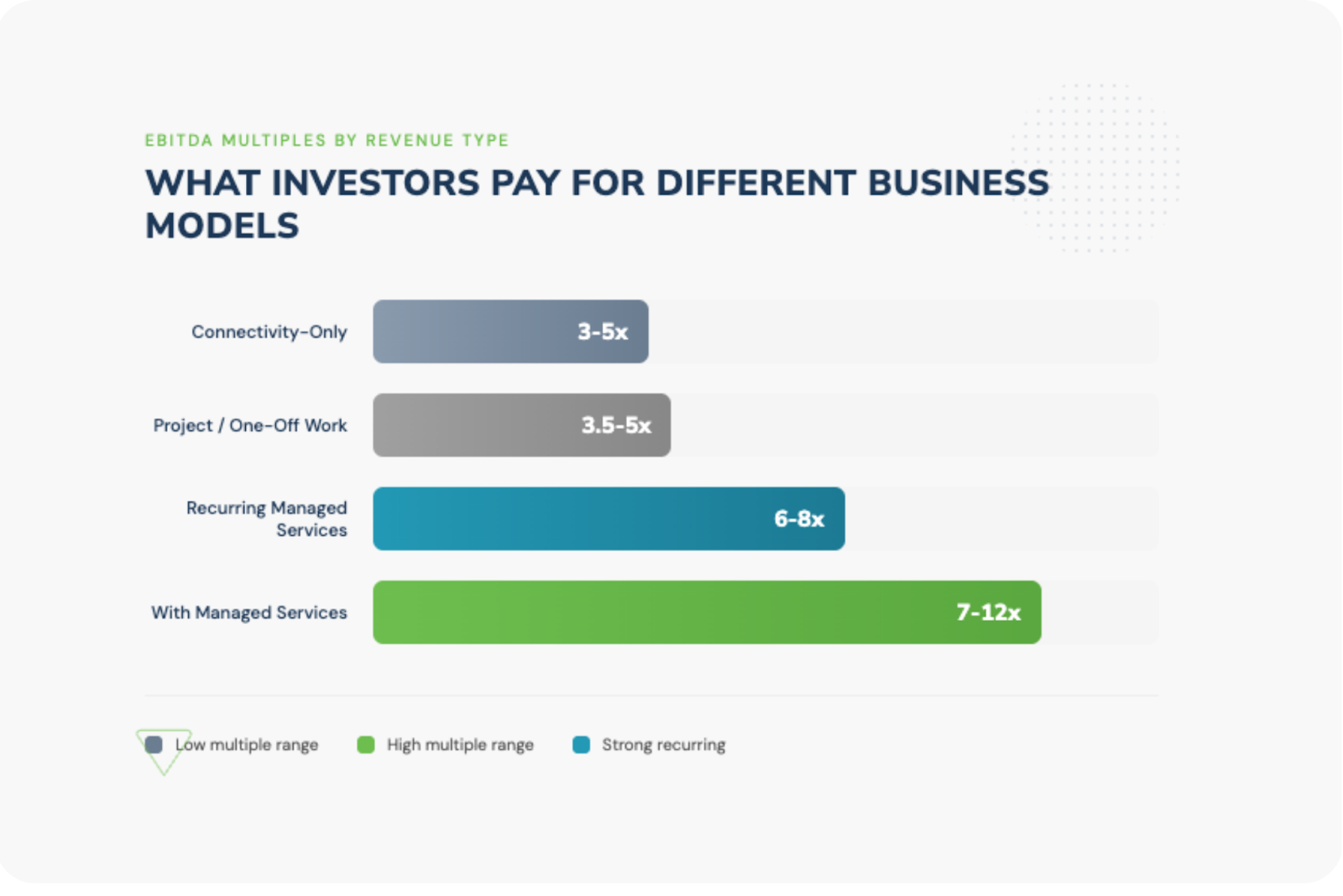
MSPs with strong recurring contracts sell at 4.5x to 8.0x EBITDA. Connectivity-only CSPs without managed services? Closer to 3-5x. Same effort. Same hours. Wildly different payoff. If you're building a business you want to sell, grow, or just sleep better owning, that gap matters.
This post breaks down why investors pay more for managed services revenue, what the math actually looks like, and what CSPs need to do to capture that premium.
Connectivity-Only Businesses Hit a Valuation Ceiling
You might be pulling in solid revenue. Healthy margins, even. But strong revenue doesn't automatically mean strong valuation. Investors discount connectivity-only businesses because they look like commodity providers: price-sensitive, easily replaced, low switching costs. When your customer can jump to a competitor with a lower quote and zero disruption, investors see that and price the risk in.
The valuation killers are always the same:
- Low differentiation. If you're selling the same circuits as the next provider, you're competing on price. Period.
- Thin margins. Connectivity margins get squeezed every year, and investors know it.
- High churn. When switching costs are near zero, customers leave for a 5% discount without blinking.
Smaller MSPs with less than $1M EBITDA trade at 3x to 5x. Connectivity-only CSPs often land in that same range because the revenue profile looks identical to investors: undifferentiated and replaceable.
We've already covered how standalone services and tool sprawl erode your margins by as much as 20%. What most CSP owners miss is that margin erosion doesn't just hurt your P&L. It shows up in your valuation. Every percentage point of margin you lose to operational inefficiency is a percentage point an acquirer reads as structural weakness.
So if your business is undervalued, the next question is straightforward: how do investors actually decide what to pay?
How Investors Actually Value CSPs
Most CSP operators have never been through an acquisition. That's fine. But you need to understand the basics, because these rules directly determine what your business is worth.
Investors don't just buy revenue. They're looking at:
- How predictable that revenue is
- How likely customers are to stick around
- Whether your margins will hold up over time
Two businesses with identical top-line numbers can get wildly different offers based on those factors alone.
EBITDA multiples are the language of acquisitions. Keep it simple: EBITDA is your earnings before the financial stuff (interest, taxes, depreciation, amortization). The multiple is what investors multiply it by to get your company's value.
Think higher multiple = higher valuation.
Here's how wide the gap actually gets:
Source: MSP Notes / Aventis Advisors
ARR matters too. Typical MSP ARR multiples run 1-2x, with higher numbers for sticky services like backup, disaster recovery, security, and cloud management. The more recurring and embedded your revenue, the more every dollar is worth to a buyer.
So that's the gap. The next question is why managed services specifically command that premium. The answer comes down to four things investors care about most.
The 4 Reasons Investors Pay More for Managed Services Revenue
Investors aren't paying a premium because managed services look good on a slide deck. The underlying business economics are fundamentally different. Here's what they're actually evaluating when they open your books:
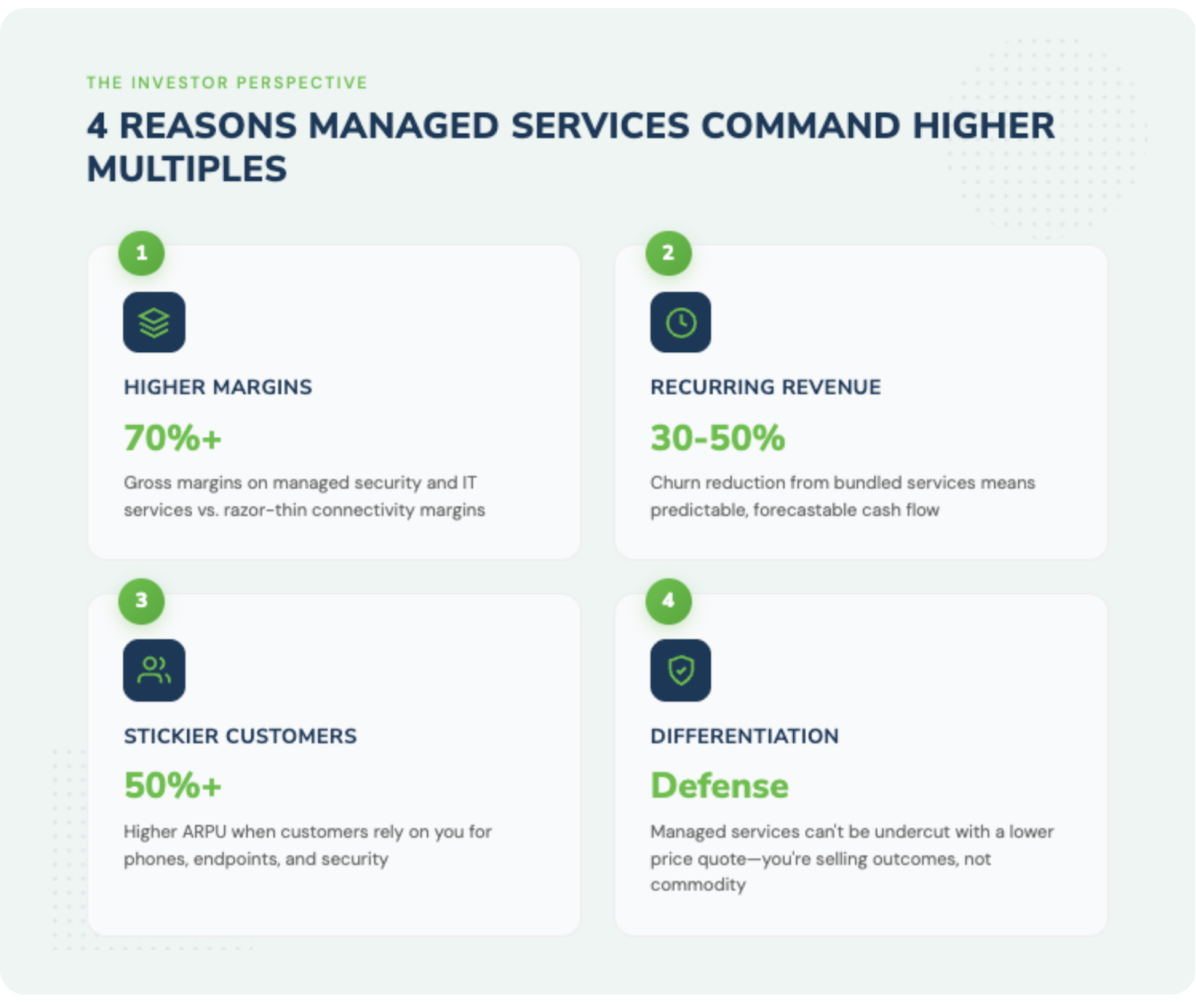
1. Higher Margins = Higher Quality Earnings
Managed security and IT services often deliver 70%+ gross margins. Compare that to the razor-thin margins on connectivity, and you're looking at a completely different business model from a buyer's perspective.
Investors pay more for margin they believe will hold up over time. High-margin recurring services signal pricing power and operational efficiency. Buyers especially favor MSPs with strong recurring revenue, low churn (90%+ retention), and cyber-focused services. Those margins tell them you're not going to get squeezed on price next quarter.
2. Recurring Revenue Reduces Risk
Bundled services reduce churn by 30-50%. That means predictable monthly revenue that doesn't disappear when a competitor undercuts you by $20 a month. Investors can actually forecast cash flow, which changes how they price the deal.
Recurring services and cloud subscriptions get significantly higher value per dollar than product resale or one-off project work. As a result, building these managed security bundles can lead to as much as 50% higher ARPU. That 30-50% churn reduction is what actually happens when you give customers a reason to stay.
3. Stickier Customers Increase Lifetime Value
More services means deeper integration into the customer's operations. When you're managing their phones, endpoints, and security, switching costs go up fast. You move from being a vendor they can swap out to a partner they'd have to rip out.
Think about it from the customer's side. Replacing you means finding a new provider, migrating services, retraining staff, and risking downtime. Most SMBs won't take that on unless something goes seriously wrong. Investors see that stickiness and price it into what they're willing to pay.
4. Differentiation Gets You Out of the Price War
Managed services change what you're actually selling. Instead of connectivity, you're delivering security monitoring, endpoint management, and business continuity. That's a different conversation with a different value attached to it.
When an investor looks at a CSP selling managed security, SD-WAN management, and UCaaS monitoring alongside connectivity, they see a business that's hard to replicate. Competitors can't just undercut your price and steal the account. That kind of defensibility is what drives multiples up.
Those are the reasons behind the premium. Now let's put actual numbers to it.
The Math: How Your CSP Can Exit Stronger with a Managed Service Offering
Take a CSP doing $10M in EBITDA. Same business, two scenarios:
Same earnings. Same headcount. The difference is how a buyer perceives the business based on what kind of revenue you're generating.
Those numbers assume you're selling standalone. Bundle to reach platform size and you can add 1-2 additional turns of EBITDA multiple compared to selling each piece separately. For CSPs, shifting 60-70%+ of gross margin to managed services and recurring contracts can push multiples from low single digits into mid or upper single digits.
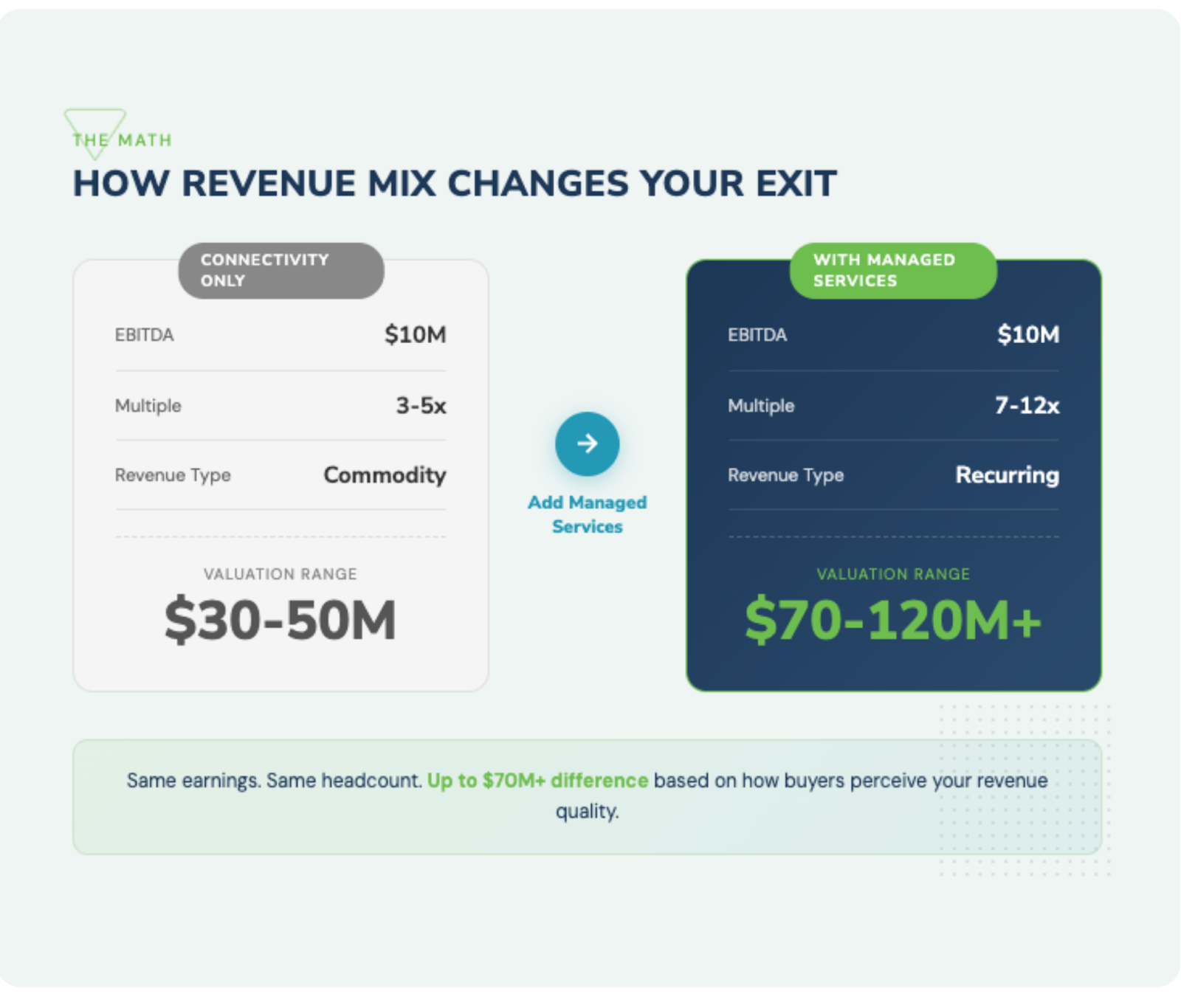
You also don't need to flip a switch and become an MSP tomorrow. Even moving 20-40% of gross profit into managed services means that portion gets valued at the higher recurring multiple instead of the lower connectivity multiple. Every dollar you shift is worth 2-3x more to a buyer. The changes compound over time.
At this point, the usual objection is: "We're a CSP, not an MSP." But you're closer to making this shift than you probably think.
Why CSPs Are Already Positioned to Expand Into IT Services
You're not starting from scratch. CSPs already have the pieces that take MSPs years to build.
- You already have billing relationships. Your customers pay you every month. Adding services to an existing invoice is a completely different conversation than cold-selling managed IT to a new prospect.
- You already have trusted access. Your customers let you into their networks. They rely on you for uptime. Managed services get built on top of that trust.
- You already have recurring contracts. The subscription model isn't new for you. Managed services are an extension of what you already do, not a reinvention.
- Customers already expect reliability from you. When you pitch security and RMM, you're offering to protect what you've already installed. It's the obvious next conversation, not a hard sell.
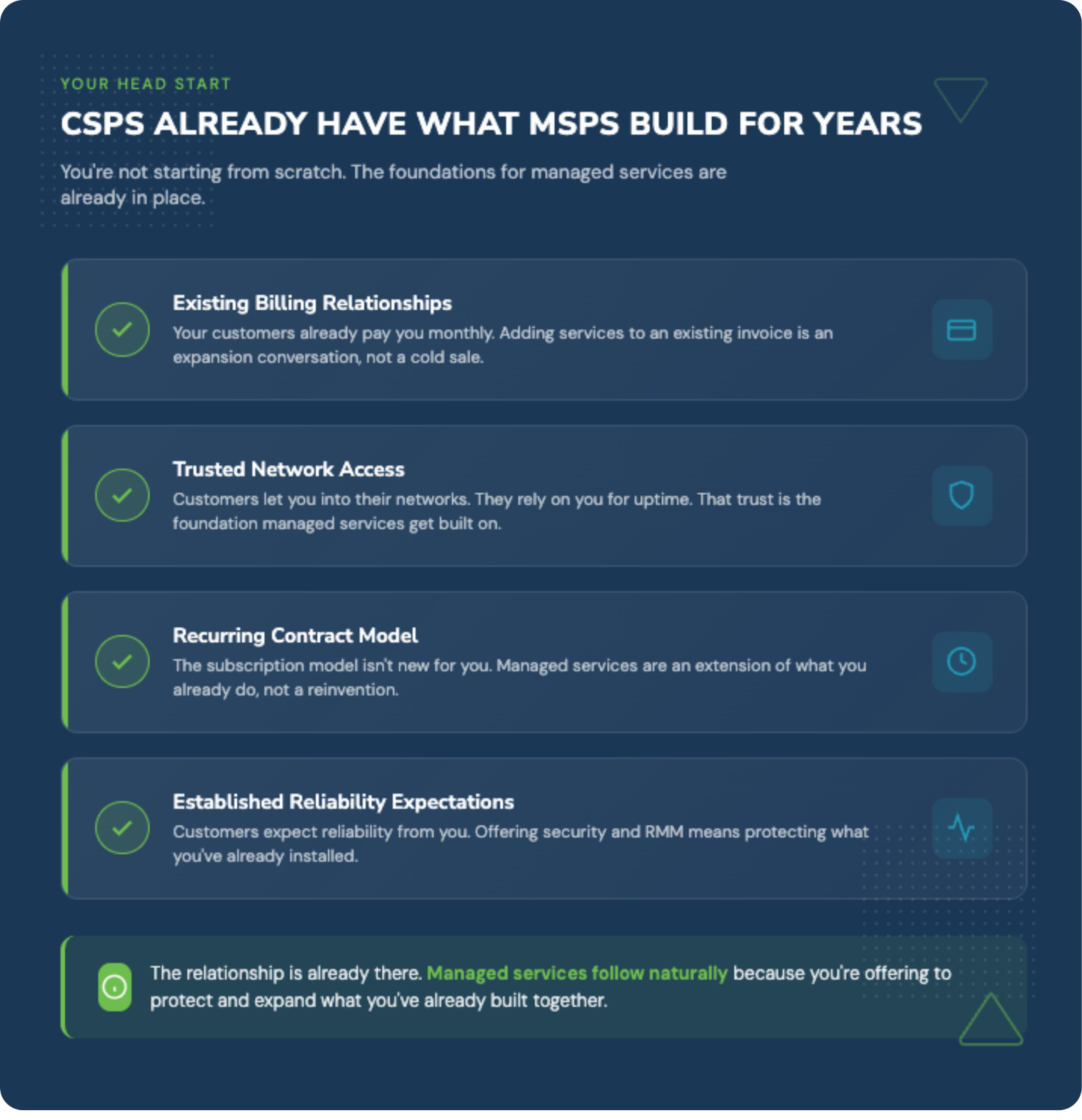
Your customer already trusts you with their connectivity. You already monitor their network. Adding endpoint security and managed Wi-Fi follows naturally because the relationship is already there.
So you're positioned and the demand is there. The thing that actually stalls most CSPs is the back office.
The CSP Barrier: Operational Complexity
Adding services is one thing… figuring out the billing component is another. Managed services introduce billing complexity most CSP back offices weren't designed for:
- Mixing usage-based VoIP charges with flat-rate security subscriptions on the same invoice
- Managing contracts across multiple tiers and service levels
- Tracking revenue across service lines that all behave differently
This is where most CSPs stall. The demand is there. Customers want these services. But the back office can't support them without manual work that eats the margin advantage you're trying to capture. Tool sprawl, fragmented billing, manual reconciliation. Same operational problems that erode your margins day to day. They're also the things preventing you from making the shift.
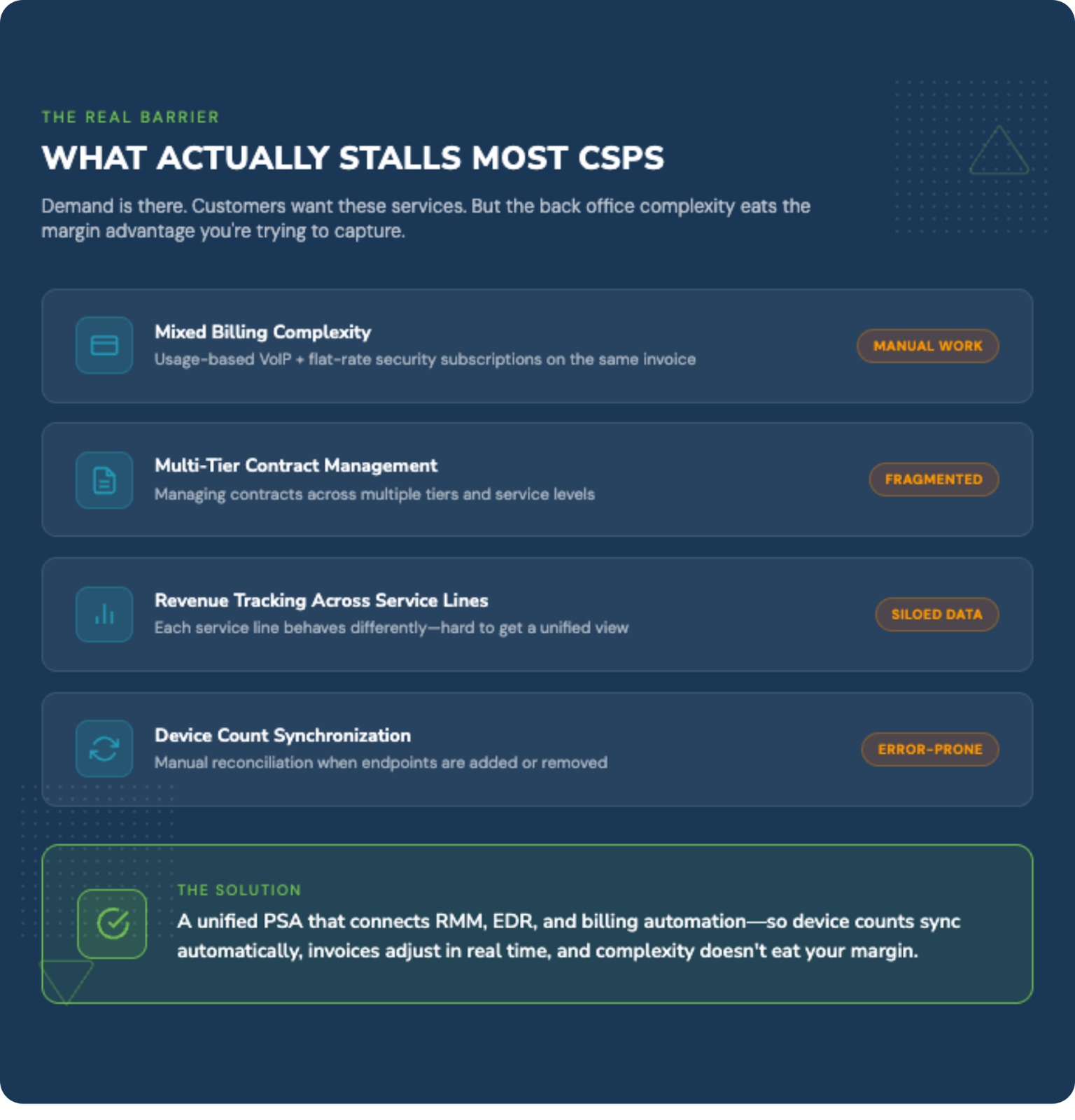
Rev.io PSA connects RMM, EDR, and cloud backup with billing automation so you're not stitching together five systems with spreadsheets in between. Device counts sync from your RMM automatically. Invoices adjust when a customer adds or removes endpoints. Contracts, renewals, and usage all run through one system built for this kind of complexity.
That operational backbone is what makes managed services work at scale. Without it, you're adding revenue with one hand and creating admin work with the other. With it, you've got the kind of clean, automated operation that looks good in due diligence and holds up under growth.
Conclusion: Managed Services Change the Trajectory of Your Business
You don't need to become a full MSP overnight. Start moving your revenue mix in the right direction. Every managed service you add, every bundle you build, every customer you make harder to leave. It compounds into a more valuable business over time.
See how Rev.io helps CSPs launch and scale managed services with a single billing and revenue platform. Request a demo.