If you're running an MSP, you're almost certainly managing three different billing models at once: recurring contracts, usage-based charges, and one-time project fees. Most MSP billing software wasn't built for that combination. And the gaps between those three models are where revenue quietly disappears.
If you're running an MSP, you're almost certainly managing three different billing models at once: recurring contracts, usage-based charges, and one-time project fees. Most MSP billing software wasn't built for that combination. And the gaps between those three models are where revenue quietly disappears.
MSPs typically lose 5 to 15% of annual revenue to billing inefficiencies. For a $2M MSP, that's $100,000 to $300,000 per year in revenue you already earned but never collected.
The fix isn't more spreadsheets or more manual reconciliation. MSPs who get this right use a single platform where all three billing types run automatically, connected to the same RMM and PSA data their team is already working in.
This post breaks down where each billing type typically breaks, what it's costing in real dollars, and what a billing system built for all three actually looks like in practice.
The 3 Billing Types MSPs Manage, and Why None Are the Same
Your billing system probably handles flat monthly contracts without much trouble. That's the easy part. The problem is you're not running one billing model. You're running three: Recurring contracts, usage-based charges, and one-time project fees. Most tools are only built for the first one. Each of the other two invoices differently, fails differently, and costs you money in a different way. Here's where each one breaks.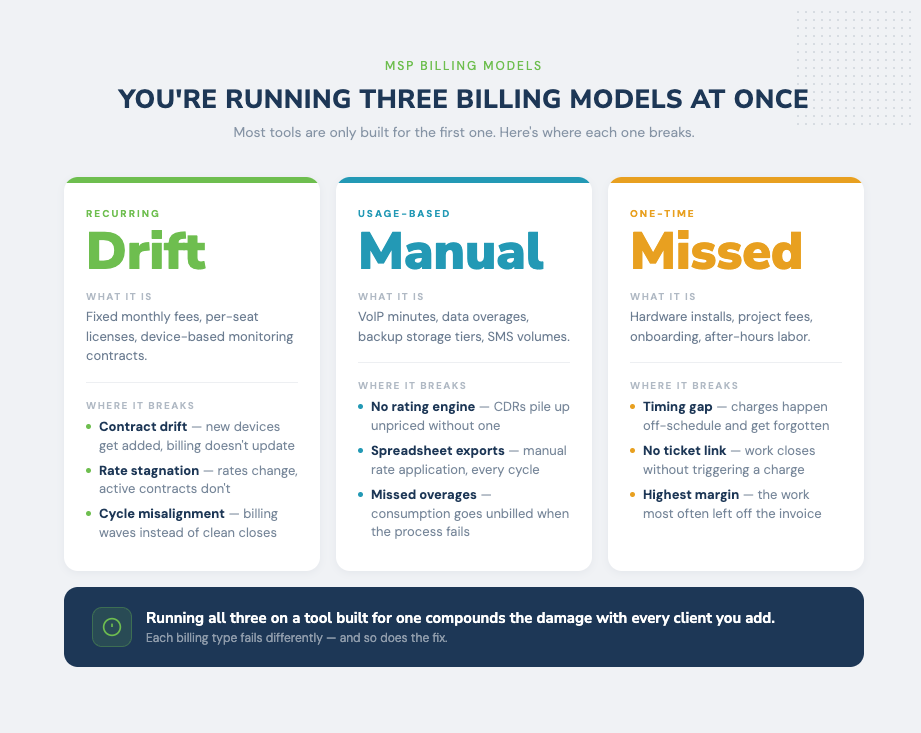
1. Recurring Billing: The Foundation with a Slow Drift Problem
Recurring billing is the core of managed services. Fixed monthly fees, per-seat licenses, device-based monitoring contracts. Most tools handle this well enough on day one. The failures are subtle and slow-building:
- Contract drift. A client adds five workstations in March, the ticket gets updated, but billing does not. Six months later you're monitoring 30 devices and invoicing for 25.
- Rate stagnation. Your labor rates went up eight months ago. Active contracts still reflect the old pricing.
- Cycle misalignment. Contract start dates are scattered across the month, so billing runs in waves instead of batching clean. Admin peaks replace a smooth monthly close.
QUICK CHECK: When did you last reconcile device counts in your RMM against quantities in your billing system? If it wasn't this billing cycle, you're almost certainly collecting less than you're owed.
2. Usage-based Billing: Where the Real Complexity Lives
Usage-based billing covers VoIP minutes, data overages, cloud backup storage tiers, and SMS volumes. Clients pay for what they use. Heavy users generate higher revenue automatically. The model is fair and good for MSP margins. The execution is where it gets hard.
Every usage charge requires four things to work correctly:
- Raw usage data. Call records, storage logs, API usage reports pulled directly from the source system.
- A rate table. Maps usage units to dollar amounts, often tiered with different rates per threshold.
- A rating process. Applies the rate table to the usage data, per account, per billing period.
- Aggregation and summary. Rolls everything up so the final invoice shows one clean charge, not 400 line items.
QUICK CHECK: How does your team calculate overage charges right now? If the answer involves exporting to a spreadsheet and applying rates manually, you're burning hours every cycle and almost certainly leaving money on the table.
3. One-time Charges: The Highest-margin Work MSPs Bill the Least
One-time charges cover hardware installs, project fees, onboarding, after-hours emergency labor. This is often your highest-margin work. It's also the most frequently missed.
The reason is timing. A one-time charge does not show up on a schedule. It happens when a project closes, when a tech delivers hardware, when emergency work gets done at 9 PM on a Friday. If your billing system does not capture that charge at the moment it happens, it depends on someone remembering to log it later. That is where revenue disappears.
QUICK CHECK: Pull your last 30 closed project tickets. How many generated a one-time charge that shows up on a client invoice? The gap between that number and 30 is revenue your team delivered but didn't collect.
All three billing types create real problems on their own. Running them simultaneously on tools built for one is where the damage compounds fast.
Why Generic Billing Tools Break Under Mixed MSP Billing
Most MSP billing softwares have one real weakness: They were designed for predictable, repeatable charges. The moment you add VoIP or close a project ticket, you're asking the system to do something it was never built for. That's where revenue walks out the door.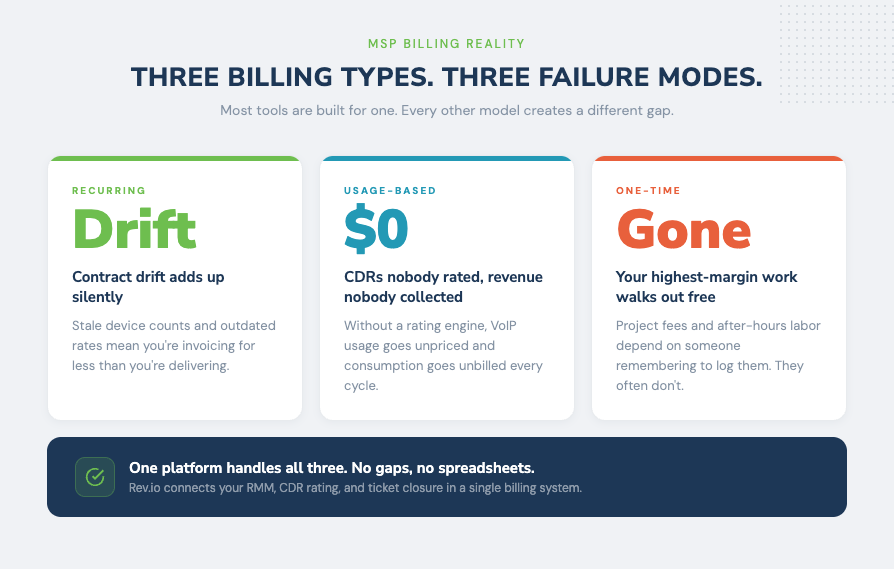
CDR Billing Requires a Rating Engine, Not a Formula
If you're offering VoIP or UCaaS, your billing system needs to process call detail records. Every phone call generates one. A 50-seat client can produce 3,000 CDRs in a month. To turn those into a clean invoice line item, you need a system that can:
- Ingest raw call records from your VoIP platform
- Match them against rate plans per account
- Apply tiered pricing logic automatically
- Aggregate everything into one readable charge
Excel can't do that at scale. Neither can a PSA module that wasn't built for telecom. MSPs who try to manage it manually build spreadsheet workarounds that break the moment call volumes grow or a rate table changes. When CDR data doesn't flow cleanly into an invoice, the revenue just disappears.
One-time Charges Need Context a Line Item Cannot Capture
One-time charges are timing-sensitive. The work happens, the ticket closes, and if your billing system doesn't capture it at that moment, it depends on someone remembering to log it later. That's where project fees, hardware installs, and after-hours labor go missing. Generic tools and legacy PSA platforms have no native way to:
- Tie a charge to a specific project ticket
- Set a billing date linked to when the work was delivered
- Flag it for review before the next invoice runs
Either someone catches it manually before the invoice closes, or it gets forgotten. Both are problems.
What Billing Fragmentation Is Actually Costing You
This isn't a new problem, but it's a persistent one. MSPs are consistently leaving significant revenue on the table through billing gaps that feel small in isolation but add up fast across a full client base. Here's what the numbers actually look like:
For context: average MSP profit margins sit around 8%, while best-in-class shops run at 18% or above. The 10-point spread between average and excellent correlates directly with operational discipline. Billing precision is one of the clearest expressions of that.
The overhead cost alone deserves attention. Think about what your billing manager actually does every month:
- Reconciling usage data
- Tracking down missed project fees
- Cross-checking tickets against invoices
That's real labor cost on work a good msp billing software should just handle. Add more clients, add more hours. At some point the billing process becomes the bottleneck, and that shows up in cash flow. 81% of MSPs aren't paid on time, and slow invoicing is part of why.
What All-In-One MSP Billing Software Built for All Three Charge Types Does Differently
Dedicated MSP billing software is architecturally different from generic accounting tools or legacy PSA billing modules. So what does an all-in-one billing system that actually handles all three charge types look like? Here's how each workflow changes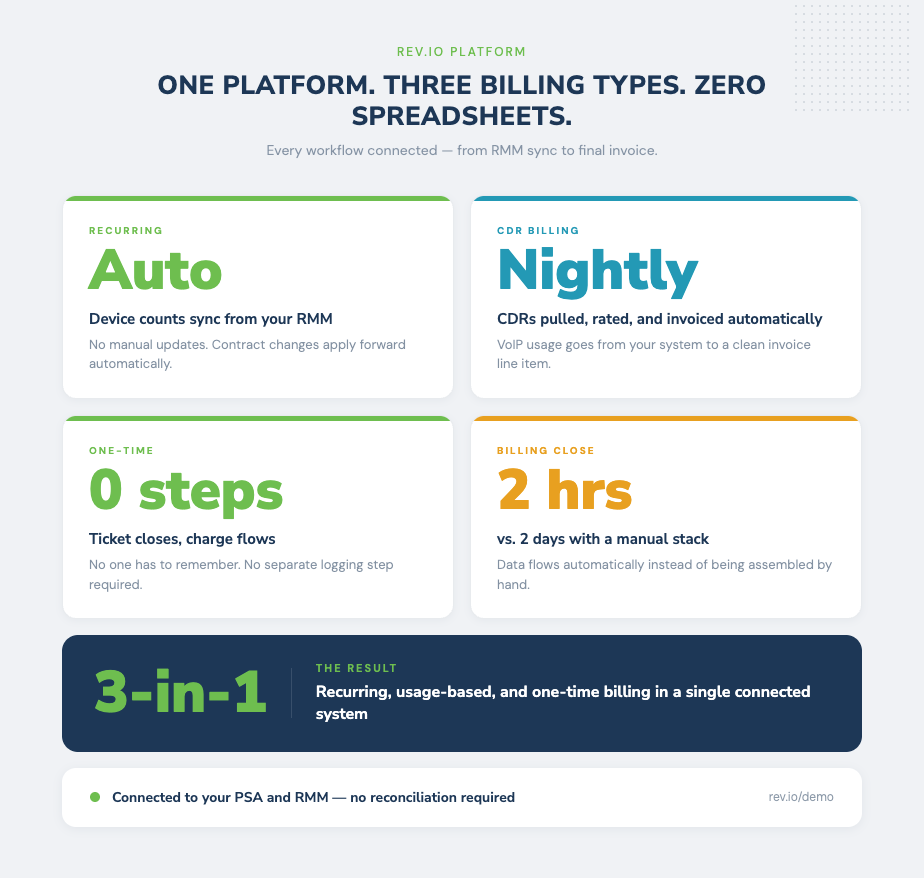
1. Recurring Billing: Set It and Stop Thinking About It
A platform built for MSPs connects directly to your RMM. When a tech adds a device, billing knows. When a contract rate changes, it applies forward automatically. What that means day to day:
- Device counts sync from your RMM without manual updates
- Rate changes apply across active contracts automatically
- Invoices generate on schedule and queue for review instead of being built from scratch
- Billing close goes from two days to two hours
2. CDR Billing: From Raw Call Records to a Clean Invoice
A purpose-built rating engine handles the full workflow your PSA module can't:
- Ingests CDR data directly from your VoIP and UCaaS systems
- Applies rate plans per account, per billing period
- Handles tiered pricing, per-destination rates, and shared account pooling
- Aggregates everything into clean invoice line items automatically
Rev.io pulls CDRs nightly, rates them against each customer's plan, and drops clean line items onto the invoice automatically. No spreadsheets. No manual exports. No revenue disappearing because a file ran wrong.
3. One-Time Charges: Project Fees That Actually Get Invoiced
When one-time charges are native to the platform, the process changes completely:
- Charges tie directly to the project ticket they came from
- Billing dates link to when the work was delivered
- Charges queue for review before the invoice goes out
In Rev.io, when a ticket closes, the billable work tied to it flows to the invoice automatically. No one has to remember. No separate step required.
Your MSP Billing Audit: 5 Questions to Run This Week
Before you evaluate any new platform or overhaul your process, you need to know exactly where the leaks are.
Most MSPs have a general sense that billing isn't running clean, but they haven't traced it back to the specific failure points.
- Is it contract drift?
- Missed one-time charges?
- CDRs that never made it onto an invoice?
The problem looks different depending on which billing type is breaking down, and the fix looks different too. These five questions will help you figure out which one is costing you the most right now. Run through them with your billing lead or ops manager and be honest with the answers.
Conclusion: Your Billing System Is either Capturing Revenue or Creating Work
Fixing billing fragmentation isn't a quick switch. It takes the right platform, a clean migration, and a team that actually adopts it. But the cost of not fixing it compounds every single month. Contract drift, unrated CDRs, missed project fees — these don't get smaller as you grow. They get harder to track and more expensive to ignore.
Rev.io was built specifically for MSPs running multiple billing models in the same stack. Recurring contracts, usage-based charges, and one-time project fees all run through a single connected system, tied directly to your PSA and RMM so the data that drives your invoices is always accurate. Say goodbye to manual reconciliation, spreadsheet dependencies and revenue falling through the cracks at ticket close.
If you're ready to see what that looks like for your operation, request a demo.