If you've added VoIP or internet services to your managed services stack, you've probably had this conversation more than once. A client asks why their bill has USF fees, E911 surcharges, and a state telecom tax. You give a vague answer about regulations and quietly hope your billing tool is handling telecom tax compliance correctly.
But the truth is, it probably isn't. And that's a big problem.
Under-collection eats your margin. Over-collection creates legal exposure. The reconciliation work piles onto your finance team every month. And when the carrier handles billing for you, the customer relationship goes with them.
What you actually want is one platform billing every service, taxes calculated correctly without a spreadsheet, your name on every invoice, and a recurring margin line where the compliance work used to be. That's the gap this blog closes, the four-layer tax structure breaking your billing, the cost-recovery math that flips compliance into margin, and the six demos to demand from any billing vendor before you sign.
4 Layers Make Telecom Tax Compliance Different From Sales Tax
When most MSPs think about tax compliance, they think sales tax. Charge the right rate, remit quarterly, done. That's the model QuickBooks and Bill.com were built on. It's also why those tools quietly fail the second you add voice services.
Telecom tax compliance is four jurisdictional layers stacked on every voice and internet invoice you send. Here's what makes each one different from sales tax:
- Federal contribution: Changes every quarter. Sales tax doesn't.
- State telecom tax: 50 different definitions of VoIP. Sales tax has one definition of a taxable sale.
- E911 surcharges: Set at the state, county, and sometimes city level. Sales tax stops at state and local rates.
- Local telecom taxes: Stack on top of all three layers above. Sales tax doesn't stack.
Here are those four layers in detail.
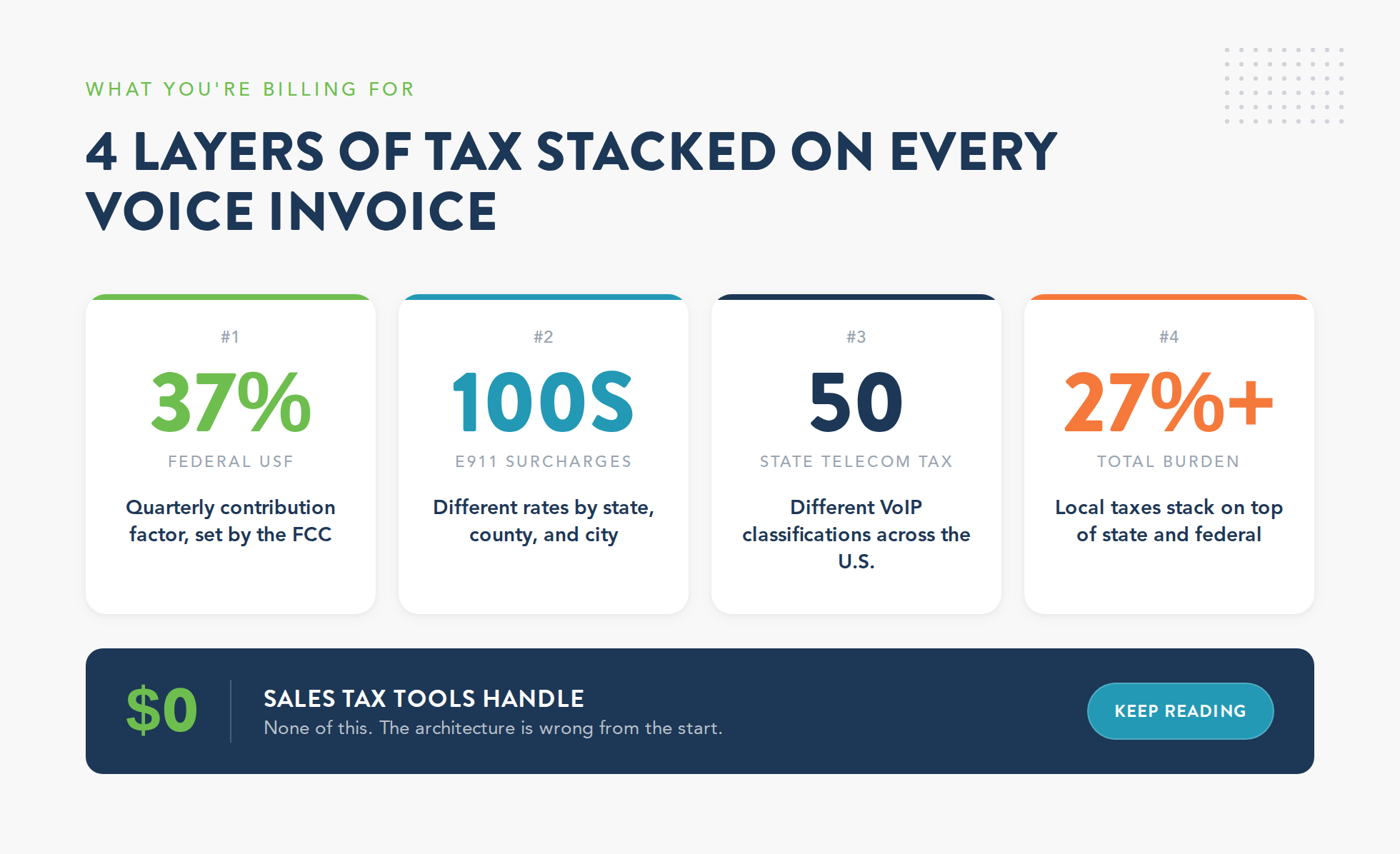
1. The Federal Universal Service Fund is now bigger than your average sales tax.
The USF is a federal fee on interstate telecom revenue. It funds Lifeline, the E-Rate program for schools, and rural healthcare connectivity. Two facts you need to know:
- The rate is now massive. The Congressional Research Service reported the contribution factor jumped from 16.7% in 2015 to 38.1% by the end of 2025. The proposed rate for Q2 2026 is 37.0%.
- It changes every quarter. The FCC sets the rate based on projected USF program demand. Your billing tool either updates automatically or you're already wrong.
- There's a de minimis threshold most MSPs miss. The 2026 USAC threshold is $37,175 in combined interstate and international telecom revenue. Cross it and you're a USF contributor with FCC Form 499 filing obligations.
USF compliance for MSPs starts with knowing what rate applies to which line item, and the rate changes every quarter. If your billing tool isn't tracking the quarterly contribution factor, you're under-collecting on every interstate voice invoice you send.
2. E911 surcharges vary by state and most counties.
Every state has its own 911 surcharge. Many counties and cities layer their own on top. The structure that breaks your billing tool:
- Rates run from a few cents to several dollars per line per month.
- Some are flat fees per line. Others are a percentage of voice revenue.
- Local rates change at the county or city level without warning.
- Multi-state voice clients = dozens of different E911 rates managed simultaneously.
A flat-rate billing module can't handle this. You either build a manual lookup table and update it forever, or you under-collect and absorb the gap.
3. State telecom taxes don't follow sales tax rules.
Most states impose a separate telecom tax on voice services with a different rate, base, and classification than sales tax. The same VoIP product can be taxed three different ways across three states.
Example: Three states, three VoIP classifications
- Florida: Communications Services Tax replaces general sales tax. State CST rate is 4.92% plus a 2.52% gross receipts tax for a combined 7.44%, with local CST surtaxes layered on top.
- Illinois: Telecommunications Excise Tax of 7% on gross charges, on top of local taxes that can hit another 8.65% in Chicago. Total wireless burden runs 37.7% per the Illinois Policy Institute.
- Idaho: Treats most VoIP as an information service. Standard 6% sales tax plus a $1 911 fee. No additional state telecom tax.
Same VoIP product. Three different invoices. A billing tool that doesn't know the difference will mis-tax every customer in at least one of these states.
4. Local taxes can push the total burden past 27%.
Cities and counties stack their own telecom taxes on top of state and federal layers. The Tax Foundation reported the total federal, state, and local burden on a typical wireless bill hit over 27% on average in 2025. In Illinois, that climbs to 37.7% on a typical wireless bill once local fees are included. VoIP doesn't carry every wireless-specific imposition, but the layered structure is identical: federal contribution, state tax, E911, and local stack.
Telecom tax compliance at this scale isn't a spreadsheet problem. It's a billing engine problem. And when generic tools try to handle it, the failures are predictable.
4 Ways Generic Billing Tools Quietly Cost You on Telecom Tax Compliance
When MSPs first add voice services, the billing problem feels solvable. Six months in, the wheels start coming off. VoIP tax management isn't something a sales tax tool retrofits its way into.
Here are the four failures generic billing tools produce on telecom tax compliance, in the order MSPs usually discover them.
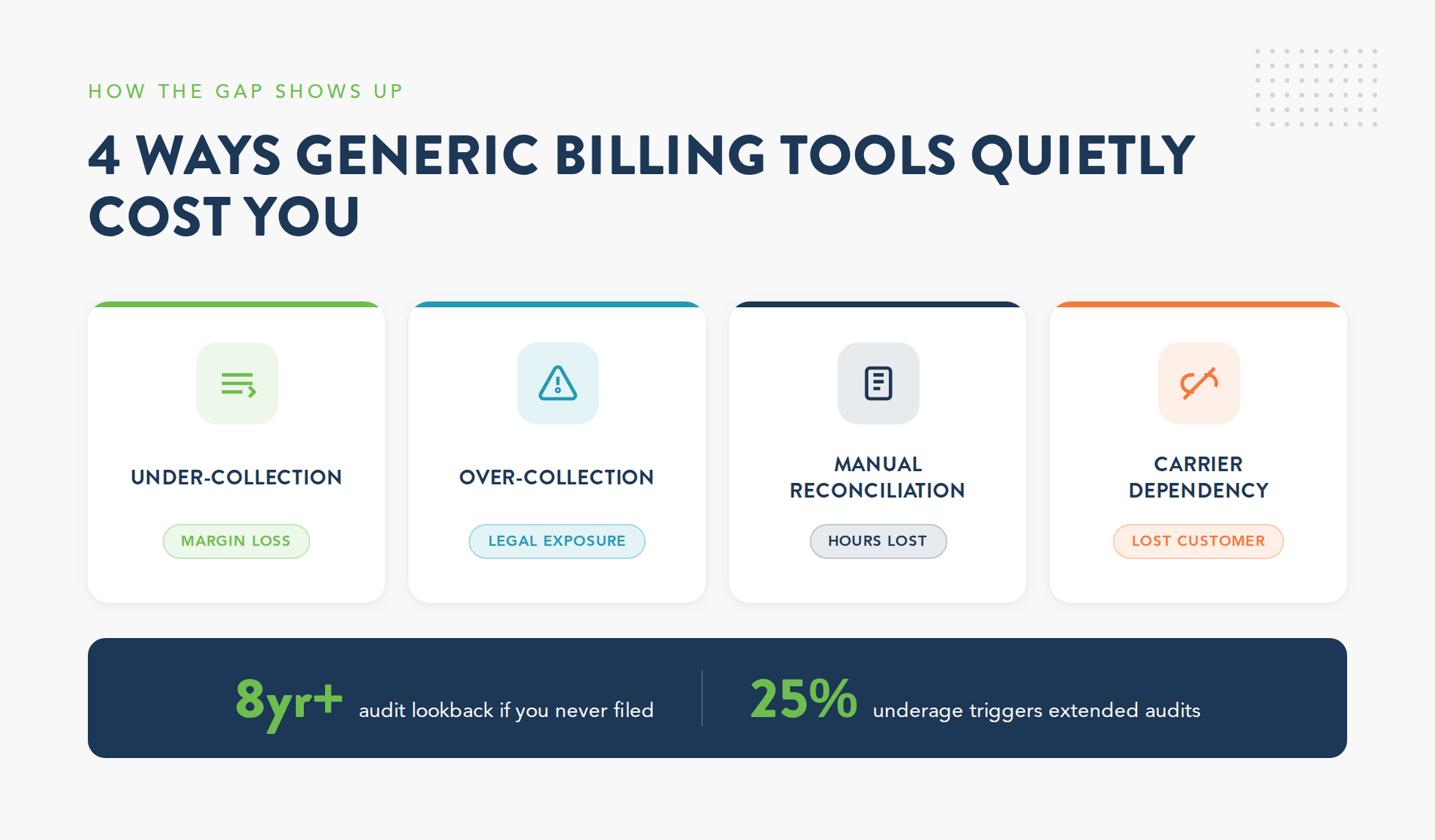
1. Under-collection eats your margin invisibly.
If your billing platform applies a flat sales tax rate to VoIP services instead of the correct USF, E911, and state telecom tax stack, you're collecting less than you owe. The shortfall comes out of your margin. The places it shows up:
- USF rate moved up two points and your tool didn't update.
- E911 rate added in a county you didn't know about.
- State telecom tax classification changed for VoIP.
- A bundled package billed at the wrong rate for half the year.
- A customer moved offices into a higher-tax jurisdiction and the system didn't recalculate.
Discovery moment is usually a quarterly remittance, when finance realizes the number you're paying doesn't match the number you collected.
2. Over-collection creates legal exposure.
The opposite failure is just as expensive. If your tool applies telecom taxes to a service that's classified as an information service in a given state, you're charging customers something you don't owe. State regulators don't take that lightly, and class action plaintiffs don't either.
Both directions create liability. Both come from the same root issue: a billing engine that doesn't know the difference between a managed IT service, a VoIP line, and a cloud service across 50 jurisdictions.
3. Manual reconciliation eats hours every month.
The workaround most MSPs land on is a spreadsheet. Someone on the billing team:
- Pulls invoice data.
- Hand-calculates the right taxes per jurisdiction.
- Adjusts the discrepancy line by line.
- Reconciles by hand against carrier statements.
- Files remittances to four to forty different agencies.
Every month. Every client. Every state. This kind of operational drag doesn't show up as a P&L line item. It shows up as billing admin headcount, missed renewals, and a finance lead who can't take vacation. It scales worse the more voice clients you sign.
4. Carrier dependency hands away your customer relationship.
The most common workaround for MSPs new to voice is letting the carrier handle taxation and billing. The trade is real:
- The carrier invoices the customer directly, or rolls everything into a wholesale rate.
- The compliance problem disappears.
- So does your customer relationship.
- Reseller margin stays thin.
- Renewal conversations go around you, not through you.
One MSP we spoke with was looking to switch carriers specifically because their setup meant the phone company didn't want to get involved with them and the client. They couldn't explain or manage their own customers' billing. That's the trade you make when you don't own telecom tax compliance: short-term simplicity, long-term loss of pricing power and retention.
What a state telecom tax audit actually looks like
State telecom tax audits are not theoretical. The lookback periods are real, and they get worse the longer you go without filing correctly:
- 3 to 4 years standard. Most state tax authorities can audit any return filed in the last three to four years.
- 6 years if you under-collected by 25% or more. Many states extend the lookback when the gap is material.
- Unlimited if you never filed at all. If you crossed the de minimis threshold and never registered, the clock never started. Some states go back 8+ years.
- Penalties stack. Fines for underreported taxes, plus interest from the original due date, plus penalty multipliers for negligence or willful non-filing.
If you bill voice services without registering and remitting, you're not running a clock. The clock is running on you.
.png)
3 Reasons Telecom Tax Compliance Becomes a Margin Lever When You Own It
This is the part most MSPs miss. When you take ownership of telecom tax compliance using a billing platform built for it, you're unlocking a recurring revenue line your competitors don't even know exists.
Here are the three places that lever shows up.
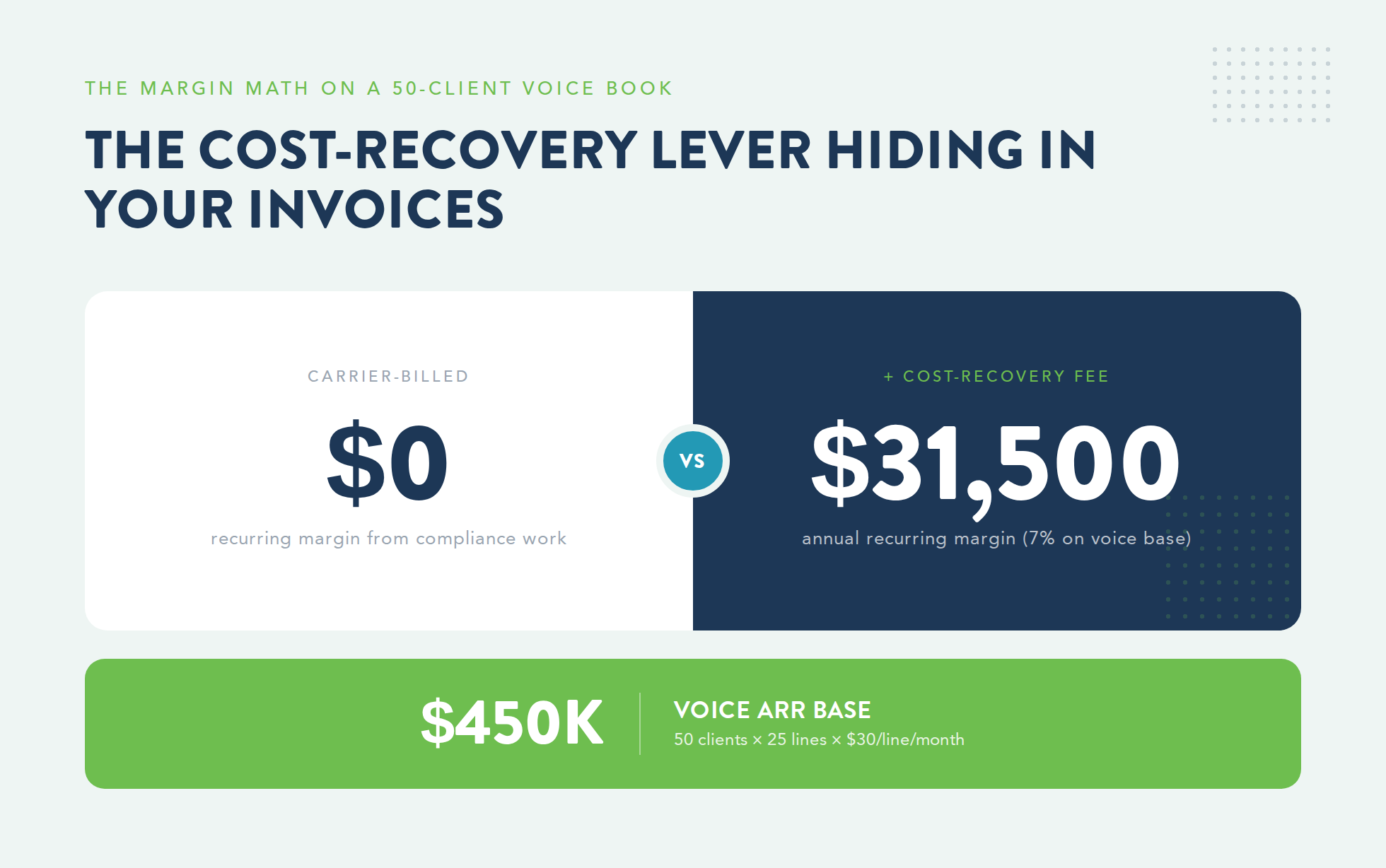
1. Cost-recovery fees are not taxes, and you set the rate.
Every charge on a telecom bill falls into one of three buckets. Most MSPs only recognize the first two:
- Pass-through taxes: You collect and remit exactly what's owed. No margin.
- Cost-recovery fees: You set the rate. These recover compliance overhead. The provider sets them, not the regulator.
- Markup: Your standard margin on top of the base service.
The middle bucket is the lever. As one operator described it: you can pass through cost-recovery fees, you get more flexibility around them, and it's more profitable in the long run.
The cost-recovery math at scale
Take a mid-sized MSP with 50 voice clients averaging 25 lines per client at $30 per line per month.
- Total voice ARR: $450,000 per year.
- Add a 5% cost-recovery fee on the voice base: $22,500 per year.
- Add a 7% cost-recovery fee on the voice base: $31,500 per year.
That's recurring margin no carrier-billed competitor is capturing, with no additional service delivered. Most MSPs don't structure this line because their billing tool can't separate cost-recovery from pass-through fees in the first place.
2. Owning the invoice means owning the markup.
When you manage your own convergent invoice instead of letting a carrier bill the customer, you control the full pricing structure. What you actually own:
- The base voice rate.
- The cost-recovery fee structure.
- The bundling logic across managed IT, voice, internet, and cloud.
- The customer's billing experience and questions.
- The renewal conversation.
The customer sees one branded invoice from you, not a confusing split between your managed IT bill and a carrier's telecom bill. This is why MSPs that have made the move into telecom services are bundling everything onto one invoice instead of running parallel billing relationships.
3. Bundled billing reduces churn at renewal.
MSPs who bundle telecom billing into the same invoice as managed IT have measurably lower churn at renewal than MSPs running parallel relationships. The retention mechanics:
- Fewer vendors for the client to manage.
- Switching costs go up because the client would have to replace two providers, not one.
- Renewal conversations go through you instead of around you.
- Service issues route to one ticket queue, not two.
That's a pricing power argument, not a feature argument. Owning telecom tax compliance is what makes the bundled invoice possible. The platform is what makes it sustainable.
How Much Cost-Recovery Margin Are You Leaving on the Table?
3 Tools MSPs Try First (and Why They Fail at Telecom Tax Compliance)
The tools most MSPs reach for when they add voice services weren't built for telecom. That's not a criticism, it's architecture. They were designed for sales tax, not federal contribution factors that change every quarter.
Here are the three most common defaults and the comparison at a glance.
| Capability | QuickBooks | Bill.com | Basic PSA | Rev.io |
|---|---|---|---|---|
| Tax jurisdiction database | Sales tax only | None | Sales tax only | Auto-updated |
| USF rate tracking | No | No | No | Quarterly |
| E911 surcharge management | No | No | Manual | Native |
| Service-type-aware tax | No | No | Limited | Per line |
| Usage-based billing | No | No | Bolt-on | Native |
| Cost-recovery fee config | Manual | No | Limited | Native |
| Bundled multi-service invoice | Limited | No | Limited | Native |
1. QuickBooks handles invoices, not telecom tax.
QuickBooks is an accounting platform. What it does well, and what it doesn't:
- Handles: invoicing, AR, basic sales tax.
- Doesn't handle: telecom tax jurisdictions, USF tracking, service-type-aware tax treatment, CDR rating.
The team running QuickBooks for telecom billing is reconciling by hand every month. The math works at five voice clients. It breaks at fifty.
2. Bill.com is a payments tool. It doesn't do telecom tax compliance at all.
Some MSPs use Bill.com for collections automation. Telecom tax functionality: zero. None.
One MSP we spoke with walked away from a Bill.com deal mid-evaluation specifically because the platform couldn't handle the jurisdictional tax requirements they needed. Bill.com is fine for AP automation. It is not a telecom billing platform.
3. Basic PSA billing modules treat tax as an afterthought.
Most ticketing-native PSA platforms added billing as a secondary feature. The pattern:
- Flat-rate billing handled reasonably well.
- Time-and-materials billing handled.
- Usage-based billing as a bolt-on or third-party integration.
- Regulatory fee management as an afterthought when it exists at all.
If you're running a PSA where billing was the second or third feature shipped, telecom tax compliance is going to be a manual process layered on top. That's the pattern that pushes MSPs to evaluate a billing-first platform once their voice book hits a critical mass.
What you actually need is a billing engine built for recurring, multi-service, usage-based revenue. A real telecom compliance solution that was built for telecom providers before MSPs needed it.
.png)
6 Demos to Demand From Any Telecom Billing Vendor
If you're evaluating telecom taxation software, the vendor pitch deck is going to sound capable. The demo is where the gap shows up. Here are the six things to make any vendor walk you through live before you sign anything.
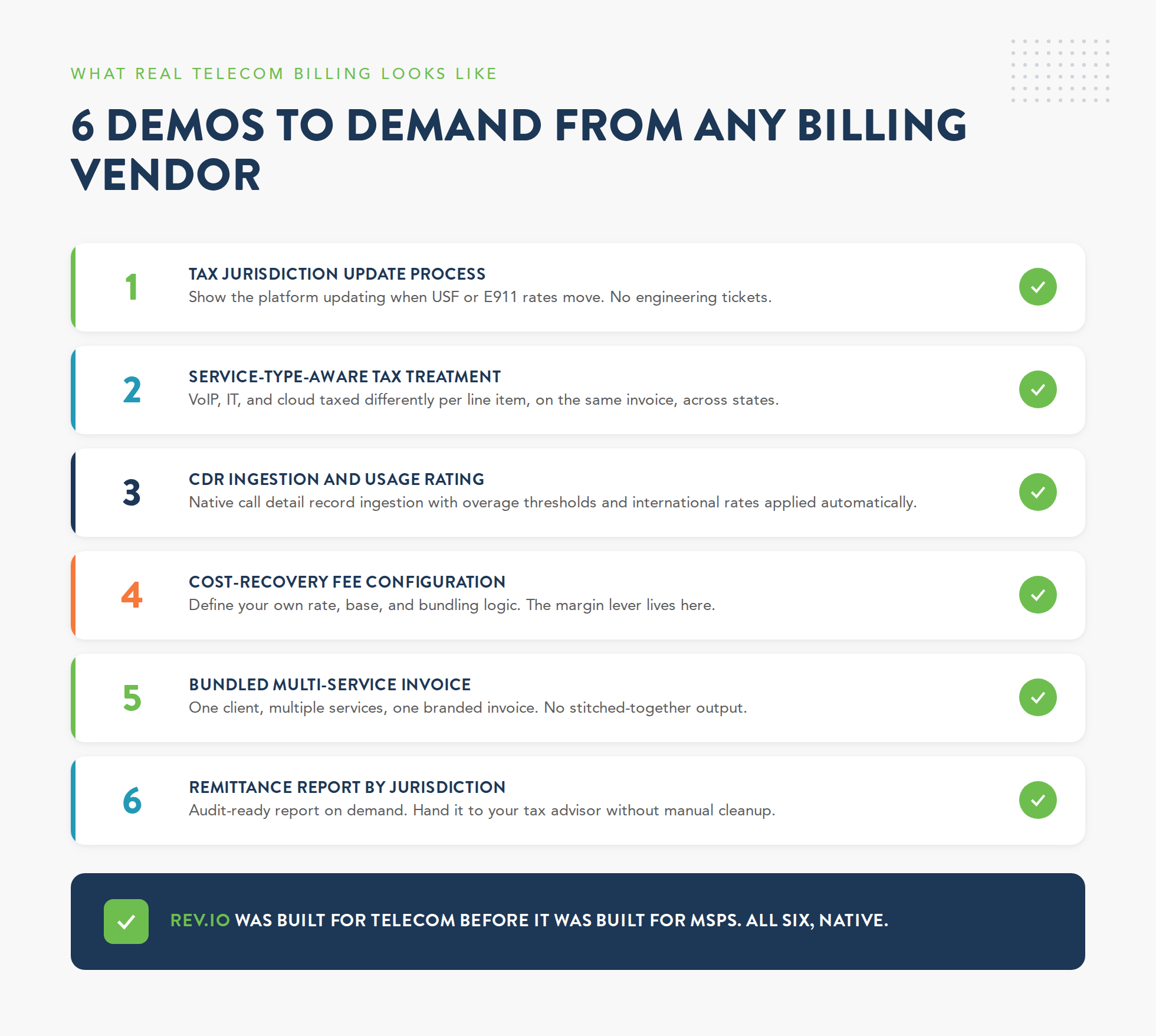
1. Show me the tax jurisdiction update process.
Ask the vendor to walk through how their platform updated when the USF rate moved last quarter. If the answer involves a manual config change or a quarterly engineering ticket, that's your job after you sign.
2. Show me how a VoIP line is taxed differently from a managed IT line on the same invoice.
Pull up a real customer with both services in three different states. The platform should apply different tax treatment per service type per jurisdiction without manual override. If it can't, you'll be reconciling forever.
3. Show me CDR ingestion and usage rating.
Watch the platform ingest call detail records and rate them automatically. Things to confirm:
- Included-minute packages tracked per client per cycle.
- Overage thresholds rated correctly without manual intervention.
- International destination rates applied by call type.
If any part requires a third-party integration or a manual step, you're looking at the same problem in a different wrapper.
4. Show me how a cost-recovery fee is configured.
This is where the profit center lives. The vendor should let you define your own cost-recovery fee, set the percentage, choose the base it applies to, and bundle it into the invoice. If the platform only passes through carrier fees verbatim, you've lost the margin lever.
5. Show me the bundled invoice.
One client, multiple services, one branded invoice. Managed IT, VoIP, internet, cloud backup, hardware. Different tax treatment per line item. One total. If the demo invoice has any sign of stitched-together output from multiple systems, ask why.
6. Show me the remittance report by jurisdiction.
Telecom tax compliance requires clean records. The platform should generate a jurisdiction-by-jurisdiction remittance report on demand, with dollar amounts collected and owed. This is the report you'll hand to your tax advisor or auditor. If it's a CSV export with manual cleanup required, plan accordingly.
Rev.io's telecom billing platform was built for voice before it was built for MSPs. Tax jurisdiction management, usage-based billing, cost-recovery fee configuration, and multi-service bundled invoicing are what the engine was designed to do.
Conclusion: Telecom Tax Compliance Pays You Back When You Own It
If you're running QuickBooks, paying for spreadsheet workarounds, or letting your carrier own the invoice on your voice clients, you're losing margin and losing the customer relationship at the same time. The longer that runs, the harder it gets to unwind. Voice clients renew on the platform that's billing them. They don't renew on the platform you wish was billing them.
Rev.io's telecom billing platform was built for telecom-grade tax compliance and usage-based billing in one engine, with the PSA workflow MSPs need to run service delivery alongside it. One invoice, one platform, one customer relationship. Request a demo.