If you’re feeling a bit overwhelmed by the wave of AI content, we hear you.
Every vendor at every conference has suddenly become an "AI-powered" solution. Your LinkedIn feed is full of people who were selling copiers six months ago and are now "AI transformation consultants." And somewhere between the tenth webinar and the fifteenth pitch deck, you stopped caring. You've got tickets to close, techs to manage, and clients who need their stuff to work.
But buried underneath all the AI noise, there are a handful of tools that are quietly making MSPs more profitable. Not because they're revolutionary. Because they handle the tedious, repetitive work that eats your margins and burns out your team. And they actually make it simple to implement.
This is a simple guide for MSPs trying to implement AI quickly and where it will make the most impact.
Why You Should Care About AI Solutions For Your MSP (Even If You're Over the Hype)
We're not going to hit you with a bunch of "AI is transforming everything" talk. You've heard enough of that. But there are three problems in your business right now that AI actually helps with, and ignoring them is literally taking money out of your pockets.
1. Your Techs Are Drowning in Busy Work
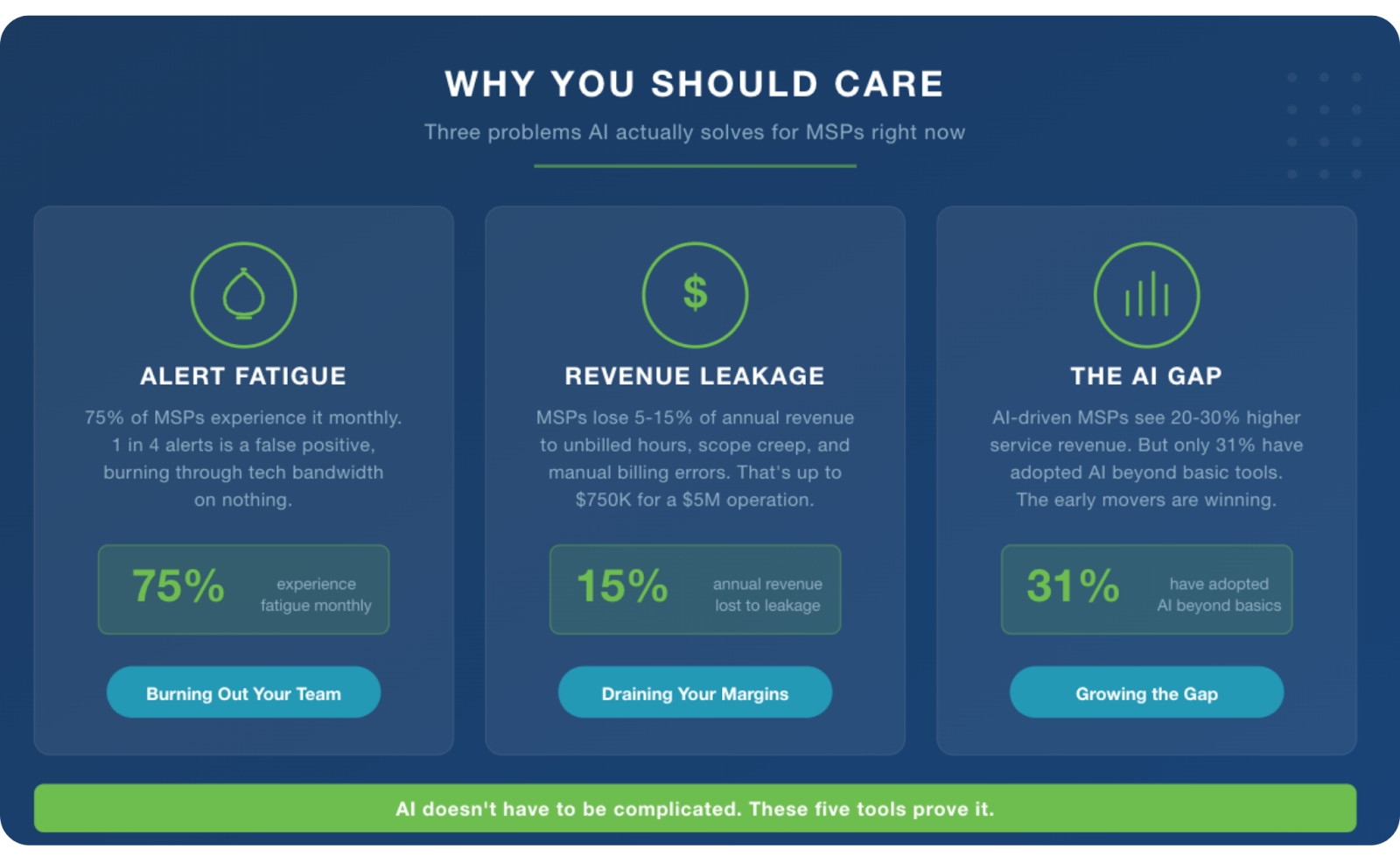
Your techs didn't sign up to babysit dashboards. But that's what they're doing. Over 75% of MSPs say their teams deal with alert fatigue at least once a month. More than half say it's happening every week. And one in four of those alerts is a false positive, which means your best people are spending a quarter of their investigative time chasing problems that don't exist.
Here's what that actually looks like on a Monday morning:
- Your service desk opens to 200+ alerts from the weekend. Half are disk space warnings on machines that auto-cleared themselves. A third are CPU spikes from scheduled updates. Your techs spend the first two hours sorting noise from real issues instead of working tickets that pay.
- A real threat gets buried in the pile. A workstation showing signs of credential theft sits at alert #147, sandwiched between printer errors and a rogue Windows update. By the time someone gets to it, the damage is done.
- Your senior tech burns out and quits. MSPs with high false-positive rates are 2.7 times more likely to experience daily fatigue. And turnover follows. Replacing a senior tech costs you 6 to 9 months of their salary in recruiting, training, and lost productivity.
2. You're Leaving Money on the Table
Your tech finishes a 45-minute firewall swap, hops in the truck, gets pulled into the next call, and forgets to log the last one. Or rounds 47 minutes down to 30 because they're standing in a parking lot and don't want to dig out a laptop. It adds up fast.
Mid-market MSPs lose 5 to 15% of annual revenue this way. For a $5 million shop, that's up to $750,000 a year. Here's where it leaks:
- Forgotten time entries. Your tech ran cable for two hours at a client site. They meant to log it when they got back to the office. They got pulled into three other things. That entry never happened. Multiply that by 15 techs, 20 days a month.
- Scope creep nobody tracked. "While you're here, can you look at this printer?" Sure, 20 minutes. Unbilled. "Can you also check why this laptop is slow?" Another 30. Unbilled. Those "quick favors" add up to entire days of free labor every month.
- Manual billing mistakes. A customer added five devices last quarter. Nobody updated the contract. You've been under-billing them for three months. Over 25% of MSPs still don't use a PSA to catch this stuff, so the leakage stays invisible until someone finally runs the numbers.
3. The MSPs Who Stopped Waiting Are Making More Money
AI-driven MSPs are reporting 20% better operational efficiency and 20-30% higher service revenue year over year. But only 31% of MSPs have actually done anything beyond playing around with ChatGPT. That gap shows up in three places:
- Faster ticket resolution. Less time diagnosing, more time fixing. More tickets closed per tech per day, which means more billable output from the same payroll.
- Higher revenue per client. When billing is automated and accurate, you stop giving away free work. When your team has capacity because they're not buried in noise, you can take on more clients or upsell existing ones.
- Lower turnover costs. Techs who aren't drowning in repetitive garbage stick around longer. That saves you the $50K to $80K it costs every time one walks out the door.
The majority of MSPs are sitting on the sideline while a third of their competitors pull ahead. Not because those MSPs are smarter. Because they picked one tool, tried it, and kept going.
5 Easy Ways to Implement AI That Will Transform Your MSP
If you're reading those stats above and thinking "great, one more thing I need to fix," we get it. But here's the good news: you don't need to overhaul your operation or hire a consultant to start closing those gaps.
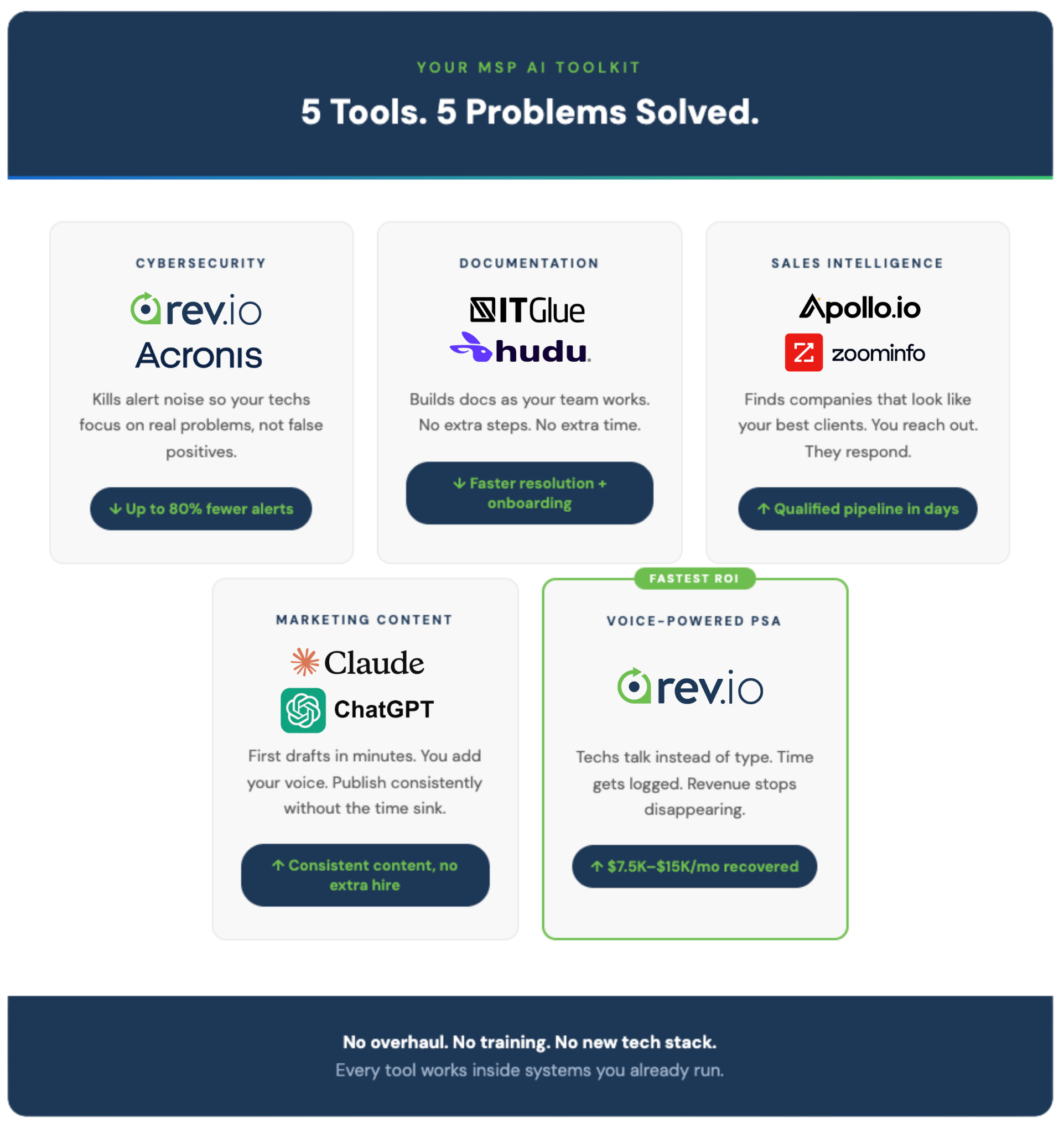
The five tools below are built for MSPs who don't have time to become AI experts. They're simple, they work inside systems you already use, and most of them take less than a day to set up.
1. AI-Powered RMM Alert Management
If your RMM dashboard looks like a slot machine every morning, you know this pain. Traditional alerting is built on static thresholds.
- CPU hits 90% for three seconds? Alert.
- RAM dips below a threshold during a routine update? Alert.
- A user restarts their machine at lunch? You guessed it. Alert.
Here's the good news: you don't need to rip out your RMM to fix this. Modern AI-powered RMM platforms layer pattern recognition on top of the monitoring you're already doing. No need for new workflows or retraining your team. The AI learns what normal looks like across your client environments and stops surfacing the stuff that doesn't matter.
Your techs don't interact with the AI at all. They just open the dashboard Monday morning and see 30 alerts instead of 200. The ones that are there actually need attention.
What changes in practice:
- The noise disappears. Disk space warnings that auto-clear, CPU spikes from scheduled updates, printer hiccups that resolve themselves. The AI filters all of it before a tech ever sees it.
- Failures get caught before they happen. AI tracks degradation patterns, like a hard drive slowly losing performance over weeks, and flags it before the crash. You fix it in a maintenance window instead of an emergency.
- Common fixes run themselves. Restarting a hung service, clearing disk space, resetting a spooler. If the fix is predictable, the AI handles it without a tech ever seeing the alert.
The shift from "we react to everything" to "we only react to things that matter" is the difference between a stressed-out team and a profitable one. And your clients notice the change too. They stop getting calls about problems and start trusting that you've got it handled.
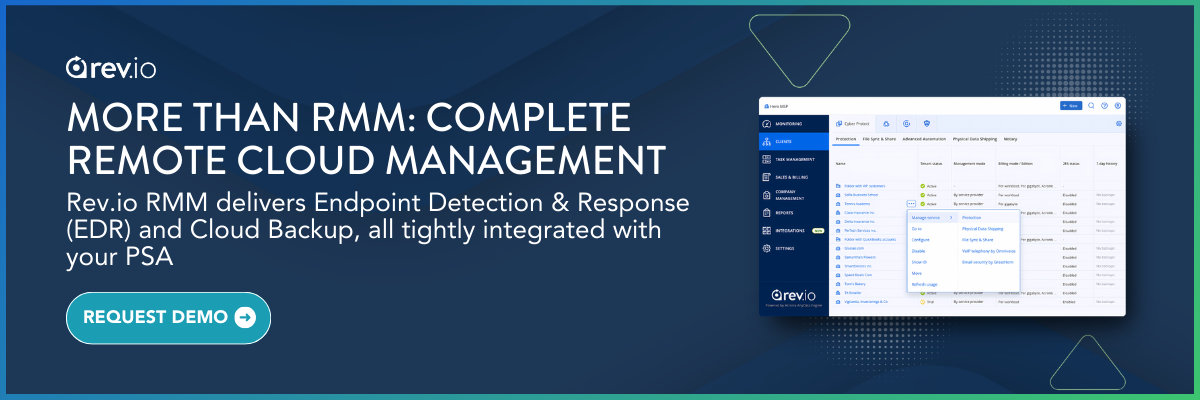
Pro tip: If you're already running Rev.io PSA, this gets even simpler. Rev.io RMM (powered by Acronis) adds AI-driven monitoring, EDR, and cloud backup directly inside your existing PSA. Alerts create tickets automatically with SLA context attached.
2. AI Documentation That Builds Itself
Documentation is the thing every MSP knows they should be doing better. It's also the first thing that gets skipped when tickets pile up. The consequences don't hit until your best tech leaves and takes half your institutional knowledge with them.
The reason documentation doesn't get done isn't laziness. It's friction. Asking a tech to stop what they're doing, open a separate tool, and write down what they just did is asking them to do the job twice. Nobody does it.
AI documentation tools like IT Glue and Hudu fix this by removing the extra step entirely. They connect to your RMM and PSA, then generate records as your team works. Your techs don't change a single thing about how they operate. The documentation just starts appearing.
- Auto-generated configuration records. Deploy a firewall? The AI captures the config and formats the documentation. Update a network? It flags related docs that might need changes. Nobody opened a template or typed a word.
- Gap identification. The system sees that you've documented 47 out of 50 client environments and highlights the three you're missing. No more discovering gaps during a 2 a.m. emergency.
- Resolution-to-knowledge-base conversion. When a tech solves a common issue, the AI suggests turning the fix into a searchable article. One click, and your knowledge base grows without anyone sitting down to write.
The real value isn't tidy records. It's faster ticket resolution because your team isn't reinventing solutions to problems someone already fixed last month. And when you hire a new tech, their ramp time drops significantly because the answers are already written down. Setup is one integration, usually under an hour, and it runs in the background from there.
3. AI Sales Intelligence for Filling Your Pipeline
Growing your MSP through cold calls and "hoping for referrals" is slow and painful. But most MSP owners don't have time to build a prospecting system from scratch, so they keep doing what they've always done and hope the phone rings.
AI sales intelligence tools like ZoomInfo, Cognism, and Apollo.io don't ask you to become a sales expert. You tell the platform what your best clients look like, and it finds more of them. That's it.
Most of these tools offer a free trial, and the setup is the same across the board: describe your ideal client, hit search, and start reaching out.
What this looks like day to day:
- Ideal client matching. Define what your best customers look like (industry, employee count, tech stack), and the AI surfaces companies that fit the pattern. Instead of dialing 100 numbers and hoping three pick up, you're reaching out to 20 companies that actually need what you sell.
- Timing signals. Some platforms detect when a company is actively researching managed services or cybersecurity. You reach out when they're already thinking about the problem, not when they're cold.
- Personalized outreach at scale. AI drafts initial emails and follow-up sequences based on the prospect's industry and likely pain points. You review it, make it sound like you, and hit send. No staring at a blank email for 20 minutes.
82% of MSPs say AI delivers the biggest benefits in their sales and marketing departments. When your best sales person spends less time researching and more time in qualified conversations, close rates go up.
4. AI Writing Tools for Consistent Marketing
You know you should be publishing content. Blog posts, educational emails, LinkedIn updates. And you know that between managing operations and putting out fires, content is the first thing that falls off the to-do list.
AI writing tools like Claude and ChatGPT don't require a marketing degree or a content strategy. You need a question your clients keep asking and about 20 minutes. That's the whole barrier to entry.
Think about the last three questions a client asked you.
- "Do I really need backup?"
- "What's the difference between antivirus and EDR?"
- "Why did my bill go up?"
Each one of those is a blog post, an email, or a LinkedIn update. You already know the answers. The AI just gets them out of your head and onto the page.
Here's how MSPs are putting these tools to work:
- First-draft blog posts. Give the AI a question and your key points. It produces a draft in minutes. You add your experience, real examples, and voice. Twenty minutes of editing and you've got something worth publishing.
- Email campaigns. Prospect nurture sequences, onboarding emails, quarterly review templates. AI generates the structure and copy, you customize for your audience. What used to take an afternoon takes an hour.
- Proposals and SOWs. Feed it the client's requirements and your service tiers. It drafts a professional document you refine instead of building from scratch.
One MSP owner in a recent industry survey said his team now creates content "much quicker than in the past" and is seeing higher engagement as a result. The magic isn't the AI. It's the consistency that becomes possible when creating content stops being a four-hour project.
5. Voice-Powered PSA for the Field
This one's the simplest tool on the list, and it's probably worth the most money.
You're under a desk running cable. You just spent 45 minutes solving a network issue. Now you need to log the time, update the ticket, and add notes. But your hands are full, your laptop is across the room, and by the time you get to it, you've rounded down and forgotten half the details.
Voice-powered PSA fixes this with something your techs already know how to do: talk.
- "Create a new ticket for Acme Corp. Their firewall is throwing errors."
- "Log 45 minutes of labor and add a note that I replaced the power supply."
- "Update the billing address for Johnson & Associates."
Done. If your tech can talk to Siri or Alexa at home, they can do this. Same concept, different output.
There's nothing to learn because there's nothing new. It works inside the PSA your team already uses. The only difference is they're talking to it instead of typing into it.
That tiny change is worth real money. MSPs commonly lose billable time because techs forget to log hours, round down out of habit, or can't stop what they're doing to open the PSA. When you remove that friction, billing accuracy goes up immediately. For a 30-person technical team, automating time capture can recover 50 to 100 previously unbilled hours monthly, which translates to $7,500 to $15,000 in revenue that was already earned but never billed.
Try the Voice Powered PSA ROI Calculator:
Rev.io's Revii agent does exactly this. It's built into the Rev.io PSA mobile app, so voice commands create tickets, log time, and update records without leaving the platform. No third-party integration. No extra subscription. It's already there.
Conclusion: Stop Overthinking AI For Your MSP
The biggest risk with AI right now isn't picking the wrong tool. It's analysis paralysis. You've sat through so many demos and read so many "ultimate guides" that doing nothing feels safer than doing something.
Don't let the hype machine keep you on the sidelines. Pick one problem. Alert fatigue? Start with AI-powered RMM. Losing billable hours? Try voice-powered PSA. Pipeline running dry? Look at sales intelligence. None of these take more than a day to set up. Most work inside systems you already run.
And if you're looking at this list thinking "I need to fix more than one of these," Rev.io handles several of them from the same platform. Voice-powered time tracking through Revii. AI-driven RMM with built-in EDR and backup through Acronis. Automated billing that catches every device and every hour. No duct-taping vendors together. No integration project. No second login.
The MSPs pulling ahead aren't geniuses. They just stopped waiting.
Request a demo of Rev.io to see how voice-powered AI and integrated PSA help your team capture more billable time and scale without adding headcount.