Most MSPs buy a PSA to help technicians close tickets faster. That's the pitch they hear, and it's not wrong. But it's wildly incomplete. The truth is, when you buy a PSA, you're not buying a dispatch tool. You're buying the central nervous system for your entire business.
The real value of a PSA isn't in operations alone. It's in aligning every department around a single system of record so your whole company moves in the same direction.
- Finance stops chasing invoices.
- Sales stops guessing at margins.
- Leadership stops drowning in spreadsheets.
That's the playbook, and it works.
Let's walk through exactly how each department gets tangible value from your PSA investment. Because when you're pitching this internally, you need more than "it'll make our techs more efficient." You need buy-in across the board.
How PSA Benefits Stack Across Your MSP
Whether you're the CEO trying to get a clear read on margins, the CFO chasing down invoice discrepancies, or the ops manager buried in manual ticket routing, the value of a PSA looks different depending on where you sit.
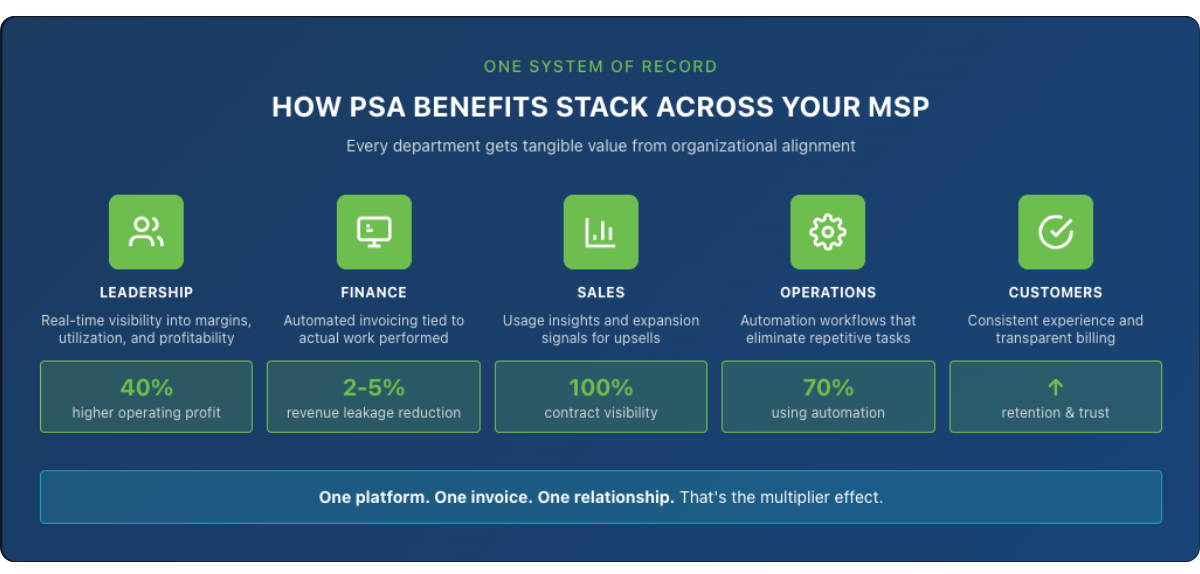
That's actually the point. A true PSA isn't built for one department. It's built to give every team in your MSP a single system they can actually rely on.
Here's how one system creates value for everyone:
|
Department |
Primary Benefit |
Measurable Impact |
|
Leadership |
Real-time business intelligence |
5-7% margin improvement, 40% higher operating profit |
|
Finance |
Automated, accurate billing |
2-5% reduction in revenue leakage, 10.5 month payback |
|
Sales |
Usage data for upsells |
Higher win rates on renewals and expansions |
|
Operations |
Automation and scheduling |
70% using automation to handle more volume |
|
Customers |
Consistent experience |
Better SLA adherence, higher retention |
1. Leadership and Executives: Real-Time Visibility Without the Spreadsheet Hell
Your executive team doesn't need another reporting tool. They need answers.
- What's our utilization rate?
- Where are margins slipping?
- Which services are actually profitable?
A PSA built for MSPs gives you those answers in real time, without waiting for Finance to build a pivot table.
The data backs this up. Organizations using PSA tools see project margin improvements of about 5-7% on average after adoption. That's real money going straight to your bottom line. You can see exactly where projects are bleeding hours and fix it before the invoice goes out.
Here's what leadership gets from a proper PSA:
- Revenue and margin visibility. See which services, clients, and teams are driving profit in real time.
- Forecasting without guesswork. Pipeline data, utilization trends, and contract renewals in one place.
- Data-driven decisions. Stop making strategic calls based on gut feel and outdated reports.
- Resource optimization. Know which techs are overbooked and which have capacity before you say yes to new projects.
- Client profitability tracking. Identify which accounts are worth growing versus which ones are draining resources.
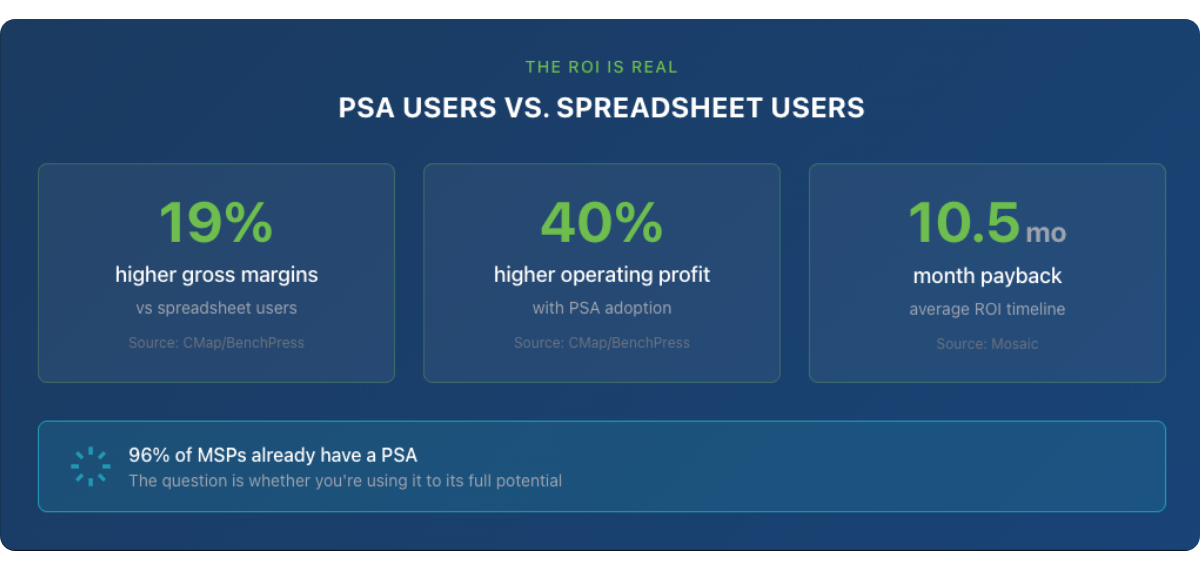
The numbers tell the story. Firms using PSA versus spreadsheets achieved 19% higher gross margins and 40% higher operating profit. When your leadership team can see the full picture without chasing data across five systems, they make better decisions faster.
What this looks like in practice:
Imagine your CEO asks which service line is most profitable. Without a PSA, you're pulling time sheets from operations, invoices from Finance, and contract data from Sales. You'll have an answer in three days, maybe.
With the right PSA, reporting is baked-in. This gives executives the ability to look at one dashboard that shows revenue, costs, and margins by service line in real time. The answer takes 30 seconds. That's the difference between reactive management and actually steering the business.
2. Finance and Billing: Accurate Invoices Tied to Real Work
Your finance team isn't trying to create billing disputes. But when invoices don't match what actually happened, disputes are inevitable. A PSA connects the work your team does directly to what hits the invoice. No more "wait, why are we billing for 40 hours when we quoted 30?"
Look, billing isn't glamorous. But it's where revenue leaks. PSA adoption is associated with a 2-5% reduction in revenue leakage through better time tracking and automated billing. That's money you're already earning but not capturing because your systems don't talk to each other.
Here's what Finance gets by implementing a PSA:
- Accurate invoicing. Every hour logged, every part used, every service delivered shows up correctly.
- Fewer disputes. When clients see exactly what they're paying for, they argue less.
- Faster AR. Clean invoices get paid faster, period.
- Revenue recognition. Track what's been delivered versus what's been billed without manual reconciliation.
- Automated billing workflows. Recurring services bill automatically at month-end without manual intervention.
- Audit trails. Every time entry, approval, and invoice adjustment is tracked and timestamped.
One PSA case study reported payback in about 10.5 months with a 39% ROI. Your CFO will understand that your PSA isn't an expense. It's an investment that pays for itself in less than a year.
The hidden cost of manual billing:
Billing is one of the most challenging aspects of running an MSP. And it makes sense… Think about how billing works now. Your techs log time. Someone reviews it. Someone else enters it into QuickBooks. Finance reconciles it against contracts. Then accounting sends the invoice. Each handoff is an opportunity for errors, delays, and missing billable hours.
With all-in-one PSA platforms, the billing is streamlined: Tech logs time → Invoice generates automatically → Client receives it. That's it. You're cutting out three steps where mistakes happen and hours go unbilled.
.png?width=1200&height=400&name=msp-ticket-reduction%20(3).png)
3. Sales and Account Management: Clear Handoff from Sold to Delivered
Your sales team closes a deal. Great. Now what? Without a PSA, that handoff to delivery is a game of telephone. Details get lost. Scope creep starts immediately. Three months later, you're delivering services you're not billing for, and nobody knows who promised what.
A PSA creates a clean handoff. Everything the client bought lives in one system. Operations knows what to deliver. Finance knows what to bill. Account management knows what to renew. No more "let me check my email from six months ago."
Here's what Sales and Account Management get:
- Contract visibility. See what you sold versus what's actually being delivered.
- Usage insights. Identify clients who are using more than they're paying for (upsell opportunities).
- Expansion signals. Track service requests that indicate readiness for additional offerings.
- Renewal intelligence. Know which contracts are coming up and what the renewal conversation should focus on.
- Client health scores. Monitor ticket volume, response times, and satisfaction to spot at-risk accounts early.
- Accurate quoting. Pull historical data on similar projects to quote more accurately.
Think about it. When your sales team can see actual usage data, they're not guessing at what to propose. They're looking at real consumption patterns and making offers that clients actually need. That's how you grow accounts without burning goodwill.
Turning service data into revenue:
Here's a real scenario: Your client has a block of 20 hours per month. Your account manager sees they've used 18-20 hours every month for the last six months… That's an upsell signal.
Instead of waiting for the client to complain about being over budget, your account manager proactively suggests upgrading to 30 hours at a better rate. You just grew the account and made the client happier. That only works when your sales team can see service delivery data.
4. Operations and Service Delivery: The PSA's Core Strength (With Compounding Benefits)
Yeah, this is where most people start. Scheduling, dispatch, SLAs. Your operations team lives in the PSA, so it better work. But here's where the math gets interesting: the operational value compounds when the rest of your business uses the same system.
When Finance, Sales, and Leadership are all working from the same data, your operations team stops getting interrupted with "quick questions" that derail their day. They're not re-explaining ticket status or digging through old notes because someone in accounting needs invoice backup.
Here's what Operations gets beyond the basics:
- Scheduling and dispatch. Get the right tech to the right place with the right skills.
- SLA tracking. Know when you're about to miss a commitment before the client does.
- Reduced rework. When techs have full context on a ticket, they fix it right the first time.
- Less context switching. One system for tickets, time tracking, parts, and customer notes.
- Knowledge base integration. Solutions to common problems are documented and searchable.
- Mobile access. Techs can update tickets, log time, and access client history from their phones.
70% of MSPs are already using automation features in their PSA and RMM, and 47% are writing scripts and using APIs. Your operations team isn't just dispatching tickets. They're building workflows that eliminate repetitive work and let them focus on solving real problems.
5. Customer Experience: Consistency and Trust
Your clients don't care about your PSA. But they care about what it enables: consistent communication, invoices that make sense, and fewer surprises. When your whole team is working from the same system, your clients get a coherent experience instead of five different stories depending on who they call.
The fact of the matter is, PSA-powered firms see faster project delivery and quicker billing cycles, which reduces disputes and improves client satisfaction. When clients can see what you're working on and why they're being billed, trust goes up. When they get blindsided by charges they didn't expect, trust tanks.
Here's what your customers experience:
- Consistent communication. Everyone on your team has the same information about their account.
- Transparent billing. Invoices show exactly what work was done and when.
- Fewer surprises. They know what to expect because you're tracking scope and communicating proactively.
- Higher trust. When you deliver what you promised and bill what you said, clients stick around.
- Client portals. They can check ticket status and history without calling you.
- Faster response times. SLA tracking means urgent issues get priority automatically.
A PSA standardizes how you work, which directly supports better SLA adherence. Your clients might not know you're using Rev.io PSA, but they'll notice that you're hitting deadlines and communicating clearly. That's what drives retention.
What clients notice:
You know what clients complain about most? Inconsistency. One tech says the issue will be fixed Tuesday. Another says Friday. The invoice shows work nobody mentioned. A PSA eliminates those disconnects.
When your client calls about a ticket, whoever answers the phone sees the same notes, the same timeline, and the same resolution plan. That's the kind of experience that makes clients renew.
The Real ROI Isn't Efficiency. It's Alignment
Look, you'll find plenty of tools that help your techs close tickets faster. That's table stakes.
Where most MSPs leave money on the table is when they buy a PSA for operations and never get the rest of the organization on board.
- Finance keeps using spreadsheets.
- Sales tracks deals in a separate CRM.
- Leadership builds reports manually.
You've got a powerful tool that only one department is using.
The real ROI of a PSA comes from organizational alignment. When everyone is working from the same system of record, you stop wasting time reconciling data and start using that data to make better decisions.
- Your margins improve because you're not leaking revenue.
- Your clients stay longer because you're delivering consistently.
- Your team is happier because they're not fighting with five different tools.
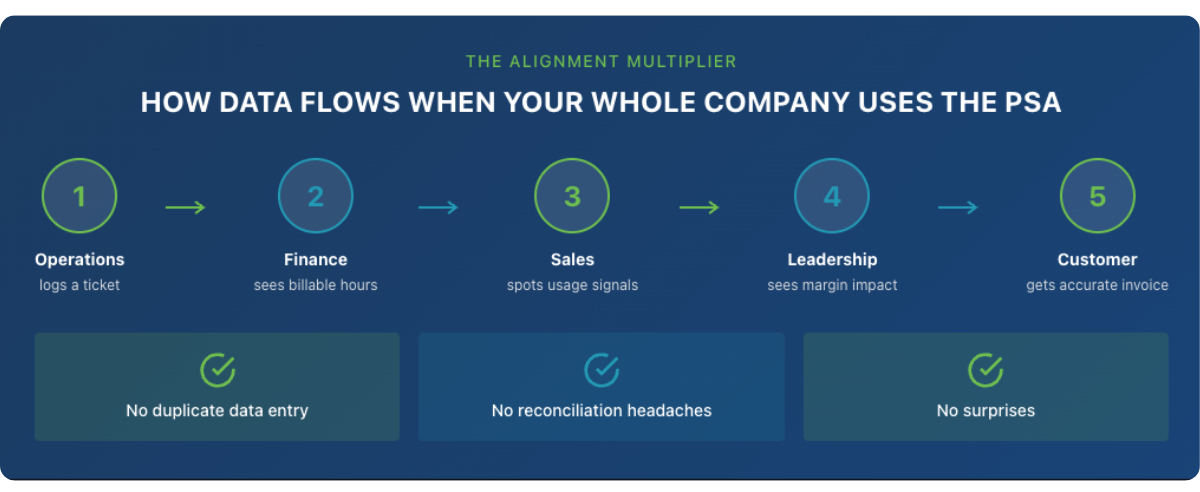
Here's what happens when your whole company uses the PSA:
Operations logs a ticket → Finance sees billable hours immediately → Leadership sees margin impact in real time → Client gets accurate invoice with full context
Each department's work feeds the next. No duplicate data entry. No reconciliation headaches. No surprises. That's the multiplier effect you miss when only ops uses the PSA.
Getting Buy-In: How to Pitch the PSA Investment Internally
When you're pitching this investment internally, don't just talk about dispatch and ticketing. Walk through what each department gains. Show Finance how it reduces revenue leakage. Show Sales how it enables upsell conversations. Show Leadership how it delivers real-time visibility without the spreadsheet gymnastics.
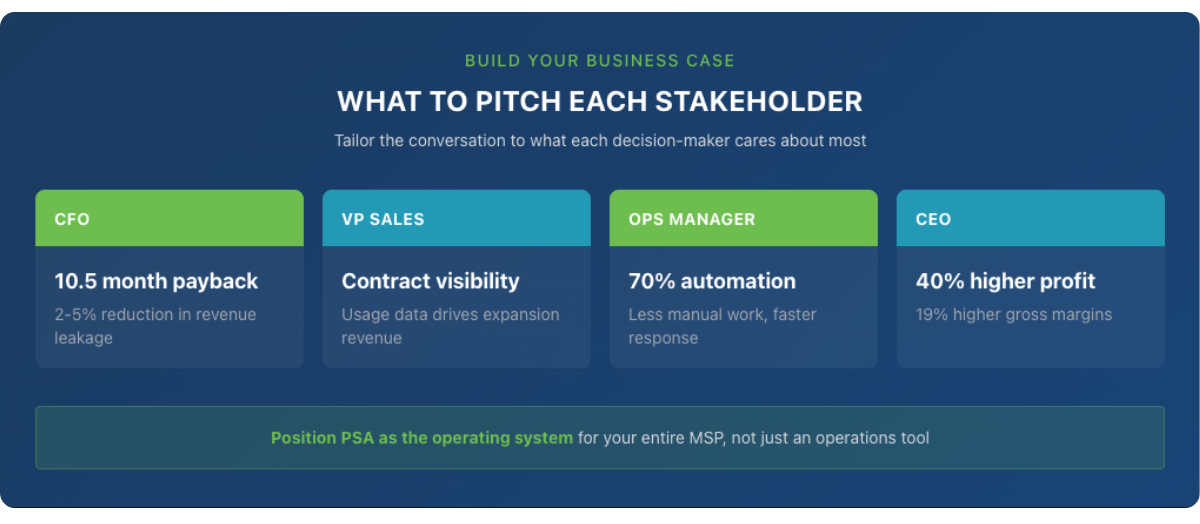
Build your business case like this:
- For the CFO. Point to the 10.5 month payback and 2-5% reduction in revenue leakage.
- For the VP of Sales. Show how contract and usage visibility drives expansion revenue.
- For the Operations Manager. Demonstrate how automation reduces manual work and improves response times.
- For the CEO. Present the 19% higher gross margins and 40% higher operating profit data.
When you position a PSA as the operating system for your entire MSP, not just an operations tool, you'll get the buy-in you need. Because the value isn't limited to one team. It's distributed across your entire organization.
Conclusion: Why Rev.io PSA Is Built Differently
Not all PSAs are created equal. Some are glorified ticketing systems. Others are so complex they require a full-time admin just to keep them running. Rev.io PSA is built specifically for MSPs who want the power of enterprise-grade tools without the enterprise-grade headaches.
What makes Rev.io PSA different:
- Built for MSPs, not adapted from other industries. Every workflow reflects how MSPs actually work.
- Integrated billing and invoicing. Finance doesn't need to export data to another system.
- Real-time reporting. Leadership gets answers without waiting for reports to run.
- Automation-first design. Reduce manual work from day one, not after months of customization.
- Straightforward implementation. You're up and running in weeks, not quarters.
Ready to see how Rev.io PSA aligns your entire business around one system? Schedule a demo and we'll show you exactly how each department benefits from a platform built specifically for MSPs.
.png?width=1200&height=400&name=The%20Complete%20Guide%20to%20MSP%20Service%20Desk%20Software%20Features%2c%20Benefits%2c%20and%20How%20to%20Choose%20the%20Right%20Tool%20(3).png)