You didn't build your MSP to manage software subscriptions. Yet here you are, juggling somewhere between 10 and 25 different tools just to deliver services to your clients. Ticketing over here, scheduling over there, security in one place, inventory in another, and a billing system that barely talks to any of it.
Every one of those tools costs money. But the real damage isn't the license fees. It's the invisible tax you pay every single day in lost productivity, wasted time, and margin erosion that doesn't show up on any line item.
The average MSP runs on 8% net profit margins. Best-in-class operators hit 18%. The difference between those two numbers often comes down to operational efficiency, and nothing kills efficiency faster than a bloated tech stack.
This guide breaks down exactly where tool sprawl is bleeding your margins, why the problem is about to get worse heading into 2026, and what consolidation actually looks like in practice.
How Your MSP’s Tech Stack Got This Bloated
No MSP operator wakes up one morning and decides to manage 20 vendors. It happens gradually. Understanding how you got here is the first step toward fixing it.
Four patterns drive most of the bloat, and you're probably living through all of them:
1. You Bought Specialized Tools for Every Function
For years, the industry advice was simple: pick the best tool for each job. That philosophy gave you:
- A dedicated security platform for RMM, EDR or Backups
- A separate ticketing system for managing service
- A standalone customer management solution
- Point products for inventory, documentation, and billing
Made sense when stacks were simpler. Now you're paying for a fragmented mess of tools that barely talk to each other.
2. Vendor "Platforms" Are Just Duct-Taped Acquisitions
The major vendors went on acquisition sprees. They bought point solutions and bolted them together, calling the result a "platform." But true integration takes years of engineering work that most vendors skip.
What you're often paying for is six separate tools wearing a trench coat pretending to be one product.
3. Every New Client Request Added Another Tool
Client asks for MDR services? New tool. Compliance reporting? New tool. Cloud management? Another new tool.
Your stack grew horizontally, not strategically. Nobody stopped to ask:
- Could an existing vendor handle this?
- Does this overlap with something we already have?
- What's the integration cost going to be?
4. Nobody's Tracking the Waste
47% of MSPs say the hardest part of tech stack management is keeping up with new tools. A third feel they have too many applications to manage.
Meanwhile, 51% of MSPs admit they don't fully utilize their tools or see strong ROI from them.
That's a lot of money walking out the door for software collecting dust.
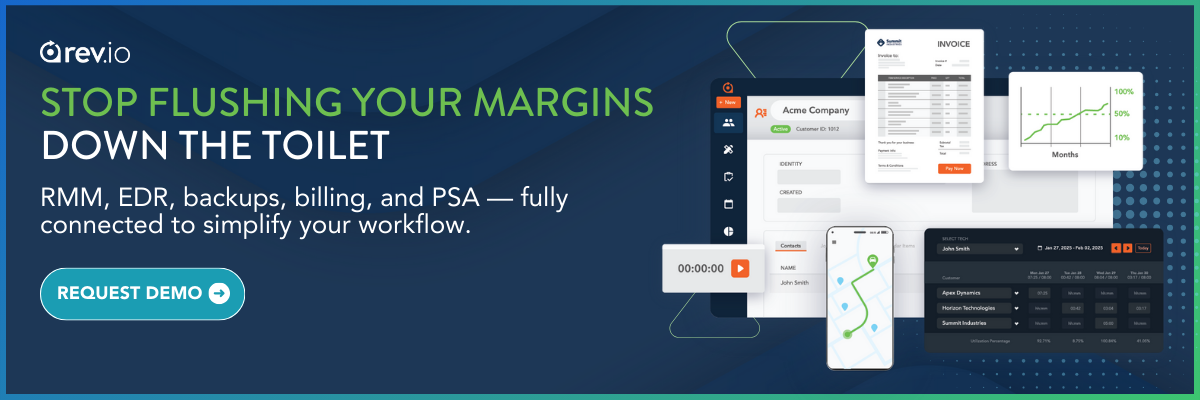
Your Tech Stack Is Costing You 20% of Your Margins (Here's the Math)
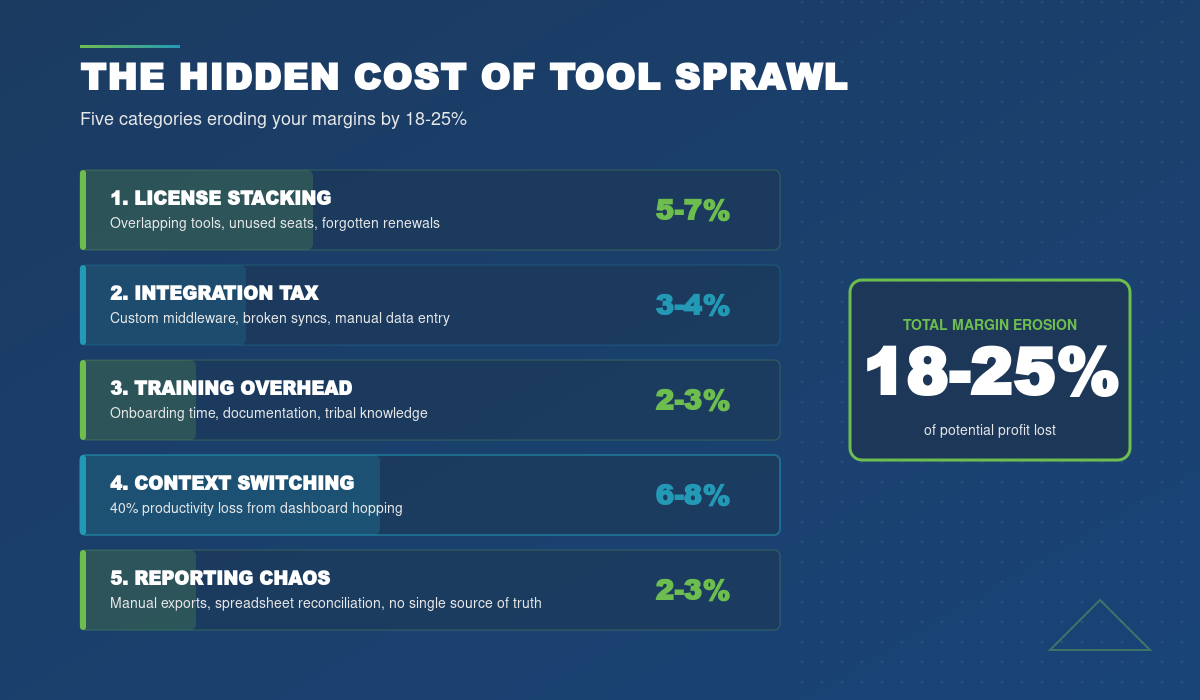
Tool sprawl doesn't show up as a single line item on your P&L. It bleeds you slowly across five areas that add up to roughly 20% of your margins. Here's how it breaks down:
1. License Stacking
You're paying for the same capability multiple times:
- Backup features in your RMM, plus a dedicated backup tool
- Security functionality scattered across three different products
- Monitoring capabilities that overlap between platforms
Most organizations only use 47% of their SaaS licenses, with 53% going unused or underutilized. For MSPs managing client environments, the waste compounds. You're not just overpaying for your own tools. You're absorbing inefficiency across every client deployment.
The shelfware problem is real:
- Licenses you bought for projects that ended
- Seats that were never deprovisioned when techs left
- Premium tiers you're paying for when basic would do the job
If software costs run 10-15% of your operating budget and half of that spend is wasted or redundant, you're looking at 5-7% of gross margin evaporating before you bill a single hour.
2. Integration Tax
Your tools don't talk to each other natively. So you build bridges:
- Zapier automations
- Custom API connections
- Middleware that someone has to maintain
Every integration is technical debt:
- Vendor pushes an update? Your custom connection breaks.
- Onboarding a new client? Someone has to configure all those integrations from scratch.
- Integration fails silently? Tickets pile up while your team plays detective.
You’re not the first MSP to deal with this… in fact, the average MSP manages 8-10 vendors. Heck, ConnectWise studies show that number can climb to 20-25! What’s important to acknowledge here is that each vendor relationship comes with its own onboarding process, support queue, training requirements, and integration headaches.
When you factor in the hours spent building integrations, maintaining them when they break, and troubleshooting failures, 3-4% of your gross margins could be going to work that clients never see and never pay for.
3. Training Overhead
Every tool has a learning curve. Every learning curve costs you time and money.
The immediate hit:
- New hire onboarding takes longer because there's more to learn
- Techs become specialists in specific platforms rather than generalists
- Knowledge silos form (when your RMM expert calls in sick, those tickets slow to a crawl)
The ongoing burden:
- Vendors push updates constantly
- Features change without warning
- New capabilities require training to use effectively
- Your team is perpetually playing catch-up, and most of that time isn't billable
Between extended onboarding, ongoing training, and the productivity hit from knowledge silos, you're losing 2-3% of margin to keeping your team competent across too many platforms.
4. Context Switching
This is the silent killer. Your techs aren't slow because they lack skill. They're slow because they're bouncing between eight different dashboards to work a single ticket.
The research is damning:
- Context switching can consume up to 40% of productive time
- It takes 23 minutes to fully regain focus after an interruption
- Knowledge workers toggle between apps over 1,200 times per day
For MSP technicians, here's what a single ticket looks like:
- Open ticket in your PSA
- Switch to RMM to check device status
- Jump to documentation platform for client-specific info
- Move to security dashboard to review alerts
- Back to PSA to update the ticket
Each switch costs cognitive load and labor is your biggest cost. If context switching eats even 15-20% of your techs' productive capacity (conservative, given the research), and labor runs 40-50% of your operating expenses, you're hemorrhaging 6-8% of gross margin to dashboard hopping alone.
5. Reporting Chaos
Client reporting means pulling data from multiple sources, normalizing it, and making it presentable. That's hours per client per month you're not billing for.
When data lives in different systems:
- Reconciliation becomes a manual process
- QBR prep turns into a multi-day ordeal
- Numbers don't match between tools, and you lose credibility with clients
If you're spending 5-10 hours per client per month on reporting that should take 1-2 hours with unified data, those unbillable hours add up to 2-3% of margin across your client base.
What Tool Sprawl Is Actually Costing Your MSP
|
Cost Area |
Margin Impact |
|
License Stacking |
5-7% |
|
Integration Tax |
3-4% |
|
Training Overhead |
2-3% |
|
Context Switching |
6-8% |
|
Reporting Chaos |
2-3% |
|
Total |
~18-25% |
3 Factors Driving Continued MSP Tool Sprawl
Tool sprawl has always been a drag on margins. But three forces are about to make it an existential problem.
1. Margin Compression from Commoditization
Basic RMM and monitoring services are becoming commoditized:
- Competitors are racing to the bottom on price
- Clients increasingly see managed services as a utility, not a value-add
- Your pricing power is dropping while costs stay high
MSP margins (8-12% on average) lag far behind other professional services like legal and financial, which run 30-35%. The MSPs that thrive in a commoditized market will be the ones who figured out how to deliver services more efficiently than everyone else.
2. The AI Tool Explosion
Every vendor is bolting AI features onto their products:
- AI-powered ticketing
- AI-driven threat detection
- AI-enhanced automation
- AI everything, from every vendor, all at once
The problem? AI is becoming another layer of tool sprawl. You're being sold AI capabilities from:
- Your RMM vendor
- Your PSA vendor
- Your security vendor
- A half-dozen startups promising to revolutionize your operations
More tools, more overlap, more confusion about what delivers value versus what's just marketing noise.
MSPs that leverage AI across their business have higher CSAT, ARPU, and projected growth rates. But that only works if AI is integrated into your existing workflows, not bolted on as yet another point solution.
3. Compliance and Security Requirements Are Spiking
The compliance landscape has shifted dramatically:
- Cyber insurance carriers are tightening their requirements
- Clients in regulated industries need documentation you didn't have to provide three years ago
- Compliance frameworks that were optional are now table stakes
Meeting these requirements means:
- More tools
- More tracking
- More reporting
- More administrative burden eating your margins
If you're adding compliance and security tooling on top of an already bloated stack, you're compounding the problem.
4 Ways Your MSP Can Eliminate Swivel-Chair Inefficiencies
The answer isn't to rip out your entire stack overnight. That's a recipe for operational chaos. Smart consolidation is a migration, not a demolition project.
Here’s how to get started:
1. Start with an Honest Audit
You can't consolidate what you can't see. Map every tool in your stack:
- What it costs
- What it does
- How much you actually use it
Most MSPs are shocked by what they find:
- Subscriptions that auto-renewed for tools nobody touches
- Premium tiers that could be downgraded
- Duplicate functionality spread across multiple platforms
74% of MSPs now say they prefer using fewer vendors, up from 64% just two years ago. And almost half call consolidation a top priority. The awareness is there. Execution is the hard part.
2. Prioritize Platform Depth Over Point Solutions
Look for platforms that handle multiple functions natively:
- RMM
- PSA
- Billing
- Service desk
All in one system. Native integration beats API connections every time. Shameless plug: Rev.io does exactly that (and was hand-crafted for MSPs).
When your ticketing system talks to your RMM talks to your billing without custom middleware:
- You eliminate entire categories of operational friction
- Your techs work in fewer dashboards
- Your data lives in fewer silos
- Your reporting pulls from a single source of truth
The old assumption was that you had to choose: best-in-class features OR operational efficiency. That's not the case anymore. Platforms like Rev.io are purpose-built to deliver both, giving you deep functionality in PSA, billing, RMM, and service desk without the integration headaches that come from stitching together point solutions.
3. Calculate True Cost Per Endpoint
Stop looking at license fees in isolation. Your true cost per endpoint includes:
- Direct costs: License fees across all tools that touch that endpoint
- Integration costs: Time spent maintaining connections between tools
- Training costs: Hours invested in keeping techs current on each platform
- Productivity costs: Time lost to context switching and manual data reconciliation
- Opportunity costs: Revenue you could generate if your techs weren't fighting your tools
When you calculate true cost per endpoint, the math often favors consolidation even if the sticker price of a unified platform looks higher than your current fragmented stack.
4. Plan the Transition
Consolidation is a project, not a weekend task. Build a realistic timeline:
- Audit your current stack and identify what stays, what goes, and what consolidates
- Select your target platform based on feature coverage, integration depth, and vendor stability
- Plan your data migration because moving client information between systems is where projects stall
- Run parallel systems during the transition so you don't drop service quality
- Train your team before you flip the switch, not after
- Migrate clients in phases rather than all at once
- Decommission legacy tools only after you've confirmed everything works
Don't try to boil the ocean. Some MSPs start with the biggest pain point (usually the PSA-RMM disconnect) and expand consolidation from there.
Conclusion: Eliminate Tool Sprawl To Gain Your Margins Back
Tool sprawl isn't just inefficiency. It's a competitive disadvantage at a time when margins are already under pressure. The MSPs that thrive won't be the ones with the most tools. They'll be the ones who ruthlessly consolidated to a platform that actually works together.
Rev.io gives MSPs the infrastructure to make consolidation work. Our unified platform connects RMM, service desk, and billing in a single system built for complex service delivery. That means automated workflows, usage-based invoicing, and operational visibility without duct-taping multiple vendors together.
Request a demo to see how Rev.io can help you reclaim the margins that tool sprawl is stealing.