You moved past dial tone years ago. When voice margins started shrinking, you expanded into UCaaS, data, wireless, maybe IoT. That's the playbook, and it worked. But there's a service line your customers desperately need that most CSPs still aren't offering: managed security.
Those same SMBs you're already serving are getting hammered by cybersecurity threats they don't understand and can't afford to ignore. 58% spend more than they planned each year on cybersecurity and 57% now say it's their top business priority. They're spending the money somewhere. The question is why aren't they spending it with you?
This guide shows you exactly how to package VoIP with managed security services to capture that spend, simplify your customers' lives, and boost your average revenue per user by 50% or more.
Why Bundling Works for Communication Service Providers
Adding security services to your catalog is easy. Getting customers to actually buy them is the hard part. That's where bundling changes the game. When you package VoIP and security together, you're not just cross-selling. You're positioning yourself as the single provider who handles two of their biggest operational headaches. And right now, that's exactly what SMBs are looking for.
Three market forces are driving this, and understanding them will shape how you structure your packages.
1. Your Customers Want Fewer Vendors
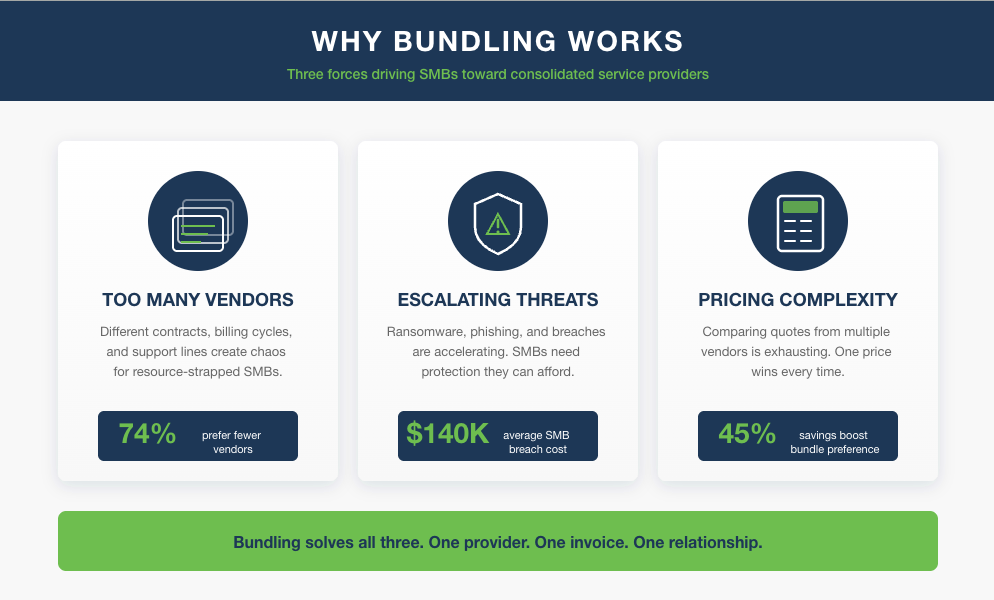
Managing multiple technology providers is exhausting for small businesses. Different contracts, different billing cycles, different support lines. The data backs this up:
- 74% of businesses now say they prefer using fewer vendors to meet their technology needs, up from 64% just two years ago
- Nearly two-thirds of MSPs say they want fewer vendors themselves, with almost half calling consolidation a top priority
This isn't about laziness. It's about survival. Your customers don't have dedicated IT staff. They don't have time to coordinate between their phone provider, their security vendor, and their backup company when something goes wrong. When you bundle services, you become the single point of accountability they're looking for.
2. Cybersecurity Threats Aren't Slowing Down
The threat landscape has gotten worse, not better. The numbers tell the story:
- The average cost of a breach for SMBs in 2025 is $140,000, a 13% rise from the previous year
- Ransomware is now tied to 75% of system intrusion breaches, with daily attacks up 126% year over year
- Phishing has surged 57.5% since late 2024
Your VoIP customers already trust you with their communications. They're already on your network. Adding security services isn't a stretch. It's a logical extension of the relationship you've already built. You're not asking them to try something new. You're asking them to let you protect what you've already installed.
3. Price Simplicity Wins Deals
Bundled pricing is easier to sell because it's easier to understand. When customers can compare a single monthly number instead of piecing together quotes from three different vendors, they make decisions faster.
Research shows that when customers save around 45% on bundled products compared to purchasing items individually, their preference for bundles increases dramatically. You don't necessarily need to discount that aggressively, but the perception of consolidated value matters:
- One invoice instead of three
- One relationship to manage
- One number to call when something breaks
The key is having a billing platform that can handle both sides of your bundle. VoIP is usage-based. Security services are typically recurring monthly revenue. If your billing system can't combine metered usage with flat-rate RMR on a single invoice, you're back to sending multiple bills and explaining line items. That defeats the whole point.
This is the foundation of the bundling strategy: you're not just upselling services. You're solving a coordination problem that your customers are desperate to escape.
The 3 VoIP and Managed Security Bundle Models That Work
Not every customer needs the same level of protection. Building tiered packages lets you meet customers where they are and create a natural upgrade path as their businesses grow. Here's a framework that works for CSPs adding IT services to their VoIP offerings.
1. Good: VoIP + Basic RMM
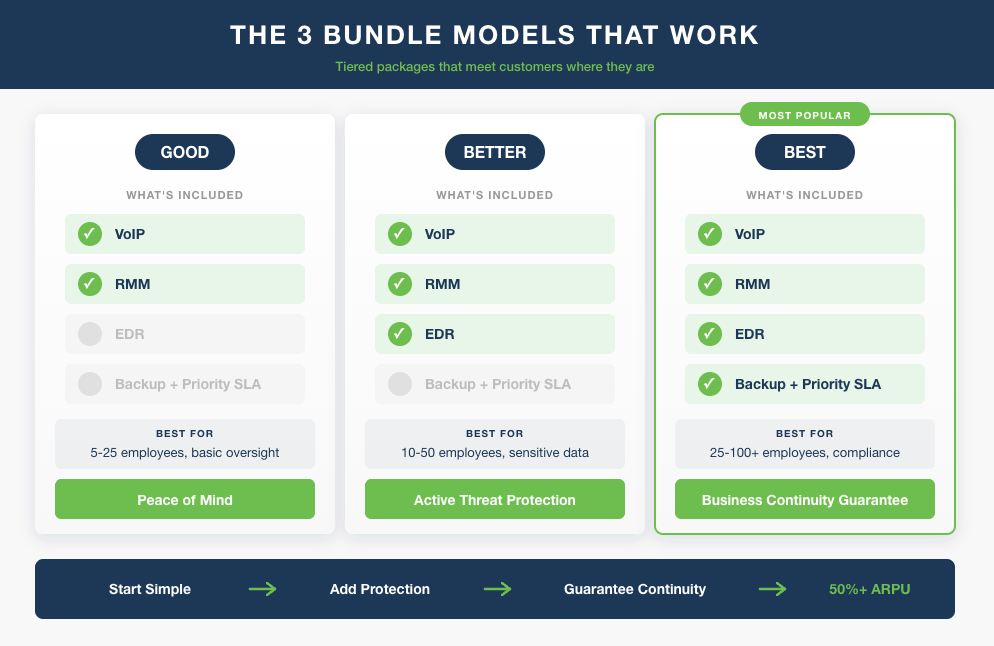
Who it's for: Small businesses with 5-25 employees who need basic visibility and maintenance but aren't ready for advanced security tools.
What's included:
- VoIP service with your standard features (auto-attendant, voicemail-to-email, mobile app)
- Remote monitoring and management covering all workstations and servers
- Patch management to keep operating systems and applications updated
- Alerting for hardware failures and performance issues, integrated with your ticketing system for automatic prioritization, time tracking, and activity logging
This tier solves the "I don't know what's happening on my network" problem. Your RMM platform delivers:
- Visibility into every endpoint on their network
- Early detection that catches problems before they become emergencies
- Automated patching that keeps systems current without manual intervention
For many small businesses, this level of oversight is a massive improvement over what they have now, which is usually nothing.
The key selling point here is peace of mind, not advanced threat protection. You're positioning yourself as the person who keeps their technology running so they can focus on their actual business.
2. Better: VoIP + RMM + EDR
Who it's for: Businesses with 10-50 employees, especially those handling customer data, processing payments, or operating in regulated industries.
What's included:
- Everything in the Good tier
- Endpoint detection and response with real-time threat monitoring
- Automated threat remediation for common attack patterns
- Security reporting with monthly summaries of blocked threats and vulnerabilities
This tier adds teeth to your security posture. 82% of breaches are caused by humans, whether through phishing, credential theft, or manual errors. EDR fills the gap by providing:
- Real-time threat detection that catches attacks basic antivirus misses
- Automated response that contains threats before damage spreads
- Visibility into attack patterns so you can harden defenses over time
The conversation shifts from "we'll keep your systems running" to "we'll keep your business safe." That's a different value proposition, and it justifies a higher price point. You're not just monitoring anymore. You're actively defending.
3. Best: VoIP + RMM + EDR + Backup + Priority SLA
Who it's for: Businesses with 25-100+ employees, compliance requirements, or zero tolerance for downtime.
What's included:
- Everything in the Better tier
- Cloud backup for critical data with rapid recovery options
- Priority SLA with guaranteed response times
- Quarterly security reviews with documented recommendations
This is your premium offering. You're not just protecting them from threats. You're guaranteeing business continuity:
- If ransomware encrypts their files, you restore from backup
- If a server fails, you're on it within the hour
- If an auditor asks about their security posture, you hand them a report
The backup component is critical here. Only 38% of SMBs report having a formal vulnerability management program in place, and even fewer have reliable backup and recovery processes. You're filling a gap that most businesses know they have but haven't gotten around to fixing.
Sample Pricing Table: Showing the ARPU Lift
Here's where the math gets interesting. These are representative price points based on industry benchmarks. Your actual pricing will depend on your costs, market, and competitive positioning.
|
Package |
Monthly Price Per-User/Endpoint |
ARPU vs. VoIP Only |
|
VoIP Only (Variable Pricing) |
$25-35 |
Baseline |
|
Good (VoIP + RMM) |
$40-55 |
+43% to +57% |
|
Better (VoIP + RMM + EDR) |
$55-75 |
+57% to +114% |
|
Best (VoIP + RMM + EDR + Backup + Priority SLA) |
$75-100 |
+114% to +186% |
RMM-only tools typically cost providers $2-5 per endpoint depending on the vendor. Managed security services that include EDR and monitoring average around $45 per endpoint, with top-performing MSPs charging up to $200. Full-stack managed IT packages (RMM, EDR, backup, and help desk) run $100 to $200 per user per month. Your bundles can land anywhere in that range depending on how comprehensive you go.
The math in action: The 50% ARPU lift target is conservative. Here's what it looks like:
- You're currently averaging $30/user on VoIP-only
- You move a customer to the Better tier at $65/user
- You've more than doubled your revenue from that account
- Even shifting 30% of your base from VoIP-only to Good tier meaningfully changes your numbers
The retention bonus: Beyond just generating more revenue per user, bundled customers are stickier customers:
- You're managing their phones, their endpoints, and their security
- Switching providers becomes a major undertaking
- That retention value compounds over time
Your Bundle Strategy Is Only as Good as Your PSA
Selling bundles is one thing. Delivering them profitably is another. This is where your professional services automation platform (PSA) earns its keep. Without proper automation, managing multiple service components per customer quickly becomes an operational nightmare.
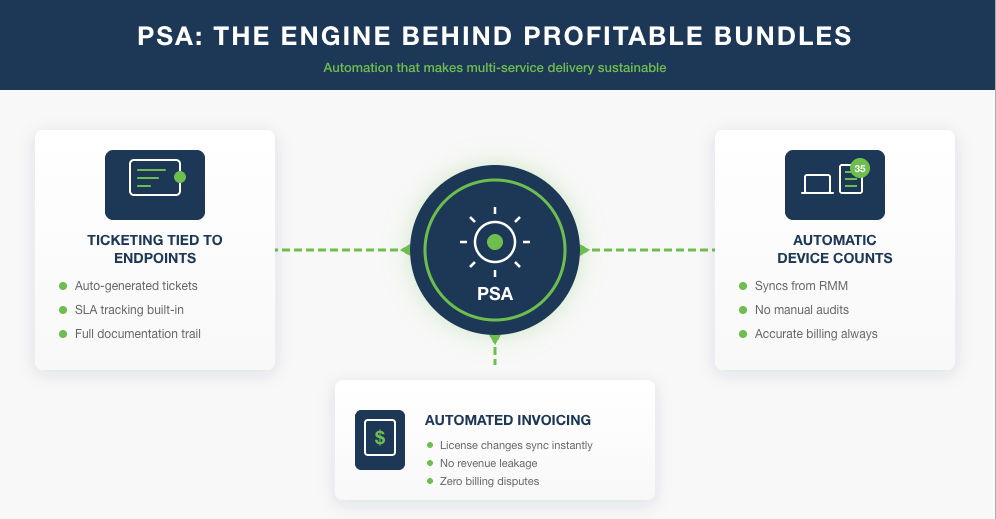
What does that automation actually look like? It comes down to three workflows that have to run without manual intervention: ticketing that responds to real-time monitoring, device counts that sync automatically to billing, and invoices that adjust the moment a customer's environment changes. Here's how each one works.
1. Ticketing Tied to Endpoints
When your RMM detects an issue, it should automatically generate a ticket in your service desk. Here's what that integration gets you:
- Automatic ticket creation when problems are detected
- SLA tracking on every resolution
- Documentation if a customer questions whether they're getting what they pay for
- Visibility into which accounts generate the most support load
That last point matters at renewal time. If a specific account is consistently high-touch, you have the data to adjust pricing accordingly.
2. Automatic Device Counts
Manual device tracking is a recipe for revenue leakage. Customers add laptops, spin up servers, and forget to tell you. Your PSA should pull device counts directly from your RMM, which means:
- Billing reflects reality without monthly audits
- No more chasing customers for updated device lists
- Protection during audits when a customer claims they only have 20 devices and your system shows 35
3. Automated Invoice Updates for License Changes
When a customer adds users or devices, your billing should adjust automatically. When they remove a server, the credit should flow through without manual intervention. The result:
- No back-and-forth that eats up admin time
- No surprises for customers
- No revenue leakage for you
- No arguments about what was or wasn't included
The goal is a billing system that's boring. The automation handles the bookkeeping so your team can focus on delivery and growth.
Launch Checklist: Getting Your First Bundle to Market
You don't need to build all three tiers on day one. Start with the Good package, learn what works, then expand from there. You could get this launched in as little as 30 days with the right playbook.
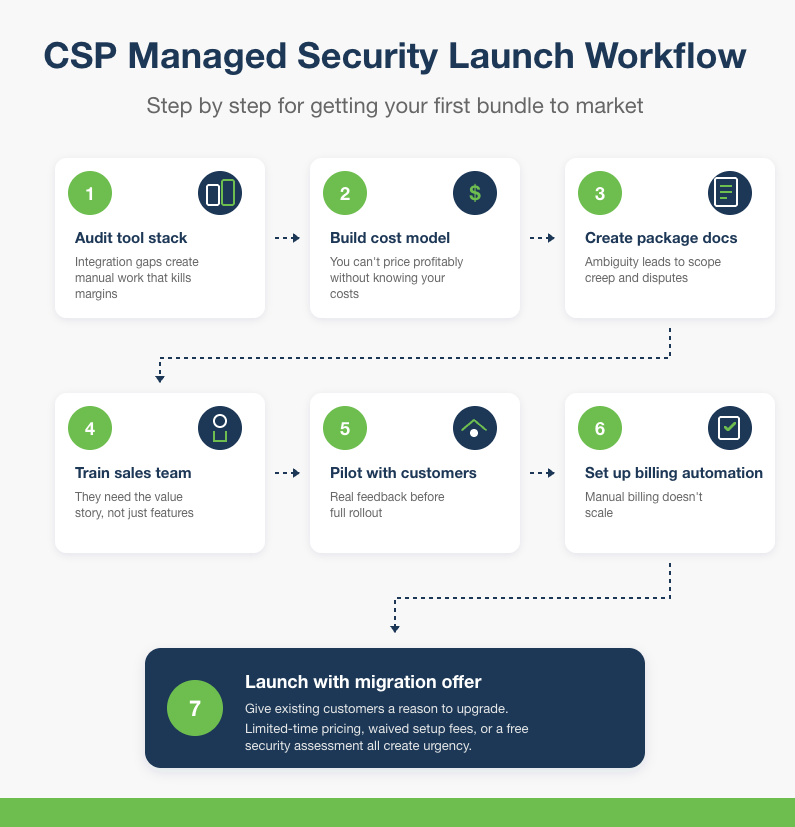
Here's the sequence:
- Audit your existing tool stack. Make sure your RMM, EDR, backup, and PSA solutions can talk to each other. Integration gaps create manual work that kills margins.
- Build your cost model. Know exactly what each component costs you per user or per endpoint before you set prices. Include labor estimates for onboarding and ongoing support.
- Create package documentation. Write down exactly what's included and excluded in each tier. Ambiguity leads to scope creep and customer disputes.
- Train your sales team. They need to understand the value story, not just the feature list. Why should a customer care about EDR? What happens if they don't have backup?
- Pilot with existing customers. Pick 3-5 VoIP customers who trust you and offer the bundle at a discount in exchange for feedback. Learn what works and what causes friction.
- Set up your billing automation. Before you scale, make sure your PSA can handle the complexity. Manual billing at 10 customers is annoying. Manual billing at 100 is unsustainable.
- Launch with a migration offer. Give existing VoIP customers a reason to upgrade. Limited-time pricing, waived setup fees, or a free security assessment all create urgency.
Remember: Don't try to boil the ocean. Get one package working profitably, then add complexity.
Conclusion: Start Capturing Security Spend
Bundling VoIP with managed security transforms your business from a commodity phone provider into a technology partner your customers can't easily replace. Start with a single tier, pilot it with customers who trust you, and let your PSA handle the billing complexity so you can scale without drowning in manual work.
Your VoIP customers are already buying security services. The money is leaving their accounts every month. The question is whether it's going to you or to someone else.
Rev.io gives CSPs the infrastructure to make bundling work. Our integrated platform connects RMM, EDR, and cloud backup with a PSA built for complex billing scenarios. That means automated device counts, usage-based invoicing, and service desk workflows that scale with your customer base. No duct-taping multiple vendors together. No manual reconciliation eating your margins.
Request a demo to see how Rev.io can help you launch your first managed security bundle.
FAQs