If you're a communications service provider (CSP), you already know the math isn't working like it used to. ARPU is shrinking 2% year-over-year. Voice revenue is flat or falling. And 35% of telecom customers switched providers last year just to save a few bucks. You're working harder for less.
But there's a revenue stream sitting right in front of you that most CSPs haven't tapped yet: managed IT services. Your customers are already buying them from someone, and right now that someone is an MSP eating into wallet share that could be yours.
The good news is AI is accelerating the convergence of telecom and IT services, which means the barrier to entry just got a lot lower. Monitoring, security, troubleshooting... it's all getting automated. You don't need a room full of IT techs to offer these services anymore. The platforms exist now to manage endpoints the same way you manage networks: continuously, remotely, and efficiently. And you've already got a NOC, a support desk, and billing infrastructure that works. Adding IT services isn't about starting from scratch. It's about using what you've built.
This guide shows you how to go from zero to billing for managed IT services in 30 days.
4 Reasons CSPs Are Built to Add IT Services
Most CSPs think adding IT services means starting from scratch. Hiring a bunch of new people. Building out a security operations center. Learning a completely different business. With modern automation tools, that's not how this works.
Look at what you've already got:
1. A support desk that runs 24/7
You're already handling customer issues around the clock. Your team knows how to triage problems, manage SLAs, and keep customers happy when things break. IT support follows the same model. Instead of troubleshooting a dropped call, you're troubleshooting a slow laptop. The skill set transfers directly.
2. Monitoring systems that work
You track network performance across your entire customer base. You know when something goes down before your customers do. Endpoint monitoring works the same way. Different devices, same concept. You're watching for problems and fixing them before they escalate.
3. Ticketing and escalation procedures
You've already figured out how to route issues to the right people at the right time. Urgent tickets get prioritized. Routine stuff gets handled in order. That workflow doesn't change when you add IT services. The tickets just come from a different source.
4. Billing infrastructure for complex services
You bill for recurring subscriptions and usage-based billing services on the same invoice. You handle prorations, overages, and contract terms without breaking a sweat. That's one of the hardest operational problems in tech, and you've already solved it. Most MSPs are still duct-taping their billing together.
5. Customers already trust you
64% of SMBs say they'd buy business and productivity tools from their telco if you offered them. They're not looking for another vendor. They're looking for the vendor they already work with to do more. That's you.
The difference between a CSP and an MSP isn't capability. It's focus. MSPs took the same playbook you use for network services and applied it to endpoints. You can do the same thing, except you've got a head start. You already have the customer relationships and billing infrastructure they spent years building from nothing.
3 Ways To Add IT Services Without Adding Headcount
The most common reason CSPs don't offer IT services is headcount. "We'd need to hire a whole IT team." "We don't have the staff to support it." "The labor costs would eat the margins."
Five years ago, that was true. Adding IT services meant technicians manually checking systems, applying patches, monitoring logs, and responding to alerts one by one. The math didn't work unless you were operating at serious scale.
That's not the case anymore.
Modern managed services aren't built around reactive labor. They're built on automation, continuous visibility, and repeatable workflows. Three foundational services made this shift possible:
1. Remote Monitoring & Management (RMM)
RMM gives you immediate visibility into customer endpoints while automating routine tasks like patching, health checks, and alerting. 60% of managed service providers say automation is the single most valuable feature in their RMM platform. The routine stuff runs in the background without anyone touching it.
2. Endpoint Detection & Response (EDR)
EDR continuously monitors for threats and suspicious behavior. It lets you deliver enterprise-grade security without building a dedicated security operations team. The platform does the heavy lifting. Your team handles the exceptions.
3. Backup & Recovery
Cloud backup services protect customer data automatically and validate recoverability without manual oversight. When ransomware hits, and it will, you're the provider who kept their business running.
When these three services are paired with Professional Services Automation (PSA), you can deliver managed IT services using the same team that's already supporting voice and connectivity. You're not adding headcount. You're giving your existing team smarter tools.
One MSP reported that switching to an automated platform saved them the equivalent of a full-time employee's salary in efficiency gains. The technology didn't replace anyone. It just made the team they already had way more productive.
If headcount has been the thing holding you back, it's time to let that go. The tools have caught up.
The CSP’s 30-Day IT Service Launch Plan
You've got the infrastructure. You've got customers who want to buy more from you. And the tools exist to do this without hiring a bunch of new people. Now it's about putting it into action.
Here's a week-by-week breakdown to get you from zero to billing for IT services in 30 days.
Days 1–7: Build a Simple Service Catalog
Don't overthink this. Start with the services every business needs: RMM, managed security, and backup. These are the easiest to sell because you don't have to convince anyone they need them. They already know.
- Create clear service tiers. Something like Essential, Advanced, and Complete. Customers should be able to look at your offerings and immediately understand what they're getting at each level. If you need a 30-minute call to explain it, it's too complicated.
- Use standardized pricing. Per-device pricing is the easiest to explain and the easiest to scale. Don't spend three weeks building a custom pricing model. You can adjust later once you see what's actually selling.
- Focus on getting to market. Your first catalog doesn't need to be perfect. It needs to exist. You'll learn more in your first month of selling than you will in six months of planning.
The goal here is repeatability, not perfection.
Days 8–14: Set Up Your Workflows
This is where PSA software earns its keep. Without it, you're just adding services and hoping your team figures it out. With it, you've got a system.
- Alerts create tickets automatically. When RMM detects an issue or EDR flags a threat, a ticket gets created without anyone lifting a finger. No manual entry. No things slipping through the cracks.
- Tickets route based on urgency. High priority stuff goes to the front of the line. Routine maintenance gets handled in order. Your team isn't guessing what to work on next.
- Technicians follow consistent workflows. Everyone handles tickets the same way. That means predictable service quality and way less "how do I deal with this?" chaos.
This is how support becomes predictable, measurable, and scalable.

Days 15–21: Pilot Internally
Before you sell this to customers, test it on yourself. Use your own team as the guinea pig.
- Deploy RMM agents on internal devices. Your laptops, your servers, your workstations. See exactly what your customers will see. Find the bugs before they do.
- Validate your EDR policies. Make sure your security alerts are tuned right. You want to catch real threats, not drown in false positives.
- Test backup and restore. Don't just confirm backups are running. Actually restore something. If you've never tested a restore, you don't have a backup. You have a hope.
This step builds confidence and lets you work out the kinks before there's a customer on the other end.
Days 22–30: Launch to Customers
You've built the catalog. You've set up the workflows. You've tested it internally. Now it's time to sell.
- Start with your existing customers. They already trust you. Offer managed IT as an add-on to their voice and connectivity services. This is the fastest path to revenue because you're not starting from scratch on the relationship.
- Add new services to existing invoices. This is where your billing infrastructure pays off. Customers see one bill with everything on it. No confusion. No extra paperwork.
- Monitor and adjust. Watch your ticket volume, response times, and customer feedback. You'll learn what's working and what needs tweaking. Don't set it and forget it.
By day 30, you're not planning anymore. You're billing.
Where the Margin Actually Comes From
Revenue is vanity. Margin is sanity. Plenty of service providers add IT services and end up working harder for the same profit, or worse. The difference between CSPs who build real margin and those who just add revenue comes down to operational integration.
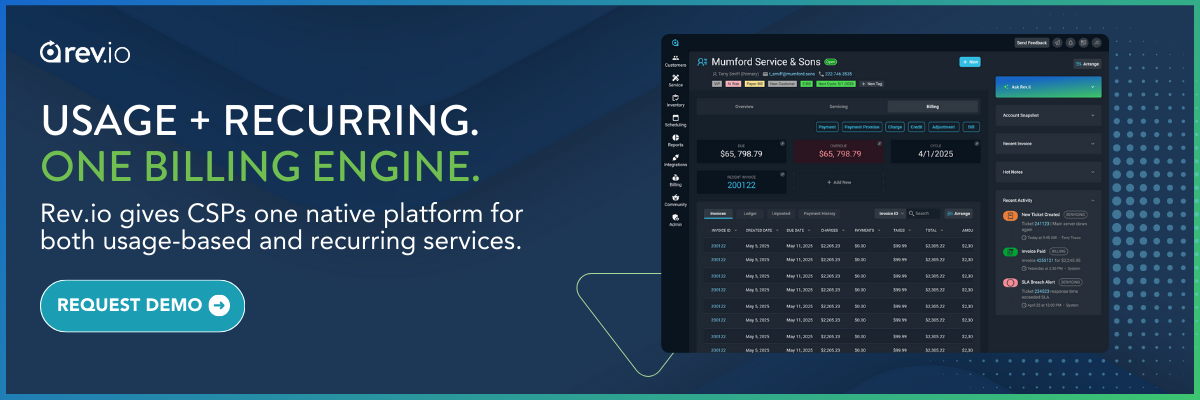
When your RMM, PSA, and billing systems work together as a unified stack:
- Device counts stay accurate. Every monitored endpoint automatically appears on invoices. No more billing for fewer devices than you're actually managing because someone forgot to update a spreadsheet.
- Technician time gets captured. Work logged in PSA translates directly to billable hours. The invisible effort that used to disappear into "customer service" becomes revenue you can measure and invoice.
- Scope creep becomes visible. When a customer asks for something outside their contract, you see it in the data. You can have an informed conversation about upgrading their tier or billing for extra services—instead of absorbing the cost unknowingly.
- Profitability becomes measurable by customer. You can see which accounts make money and which don't. That visibility lets you adjust pricing, renegotiate contracts, or exit relationships that will never be profitable.
This is how CSPs increase ARPU, reduce churn, and protect margins without proportionally increasing operational overhead. The IT & telecom sector already accounts for roughly 18-19% of global IT services spending—there's real money available for providers who execute with discipline.
Conclusion: Start Billing for IT Services
You've got the infrastructure, customers who trust you, and tools that handle the heavy lifting. Adding IT services isn't about becoming a different company. It's about doing more with what you've already built.
But the thing that ties it all together is PSA. Without it, you're just bolting on services and hoping for the best. With it, alerts become tickets, tickets become action, and action becomes revenue.
Rev.io PSA was built for CSPs. It integrates with your existing billing, connects with RMM and security tools, and gives your team one place to manage everything.